
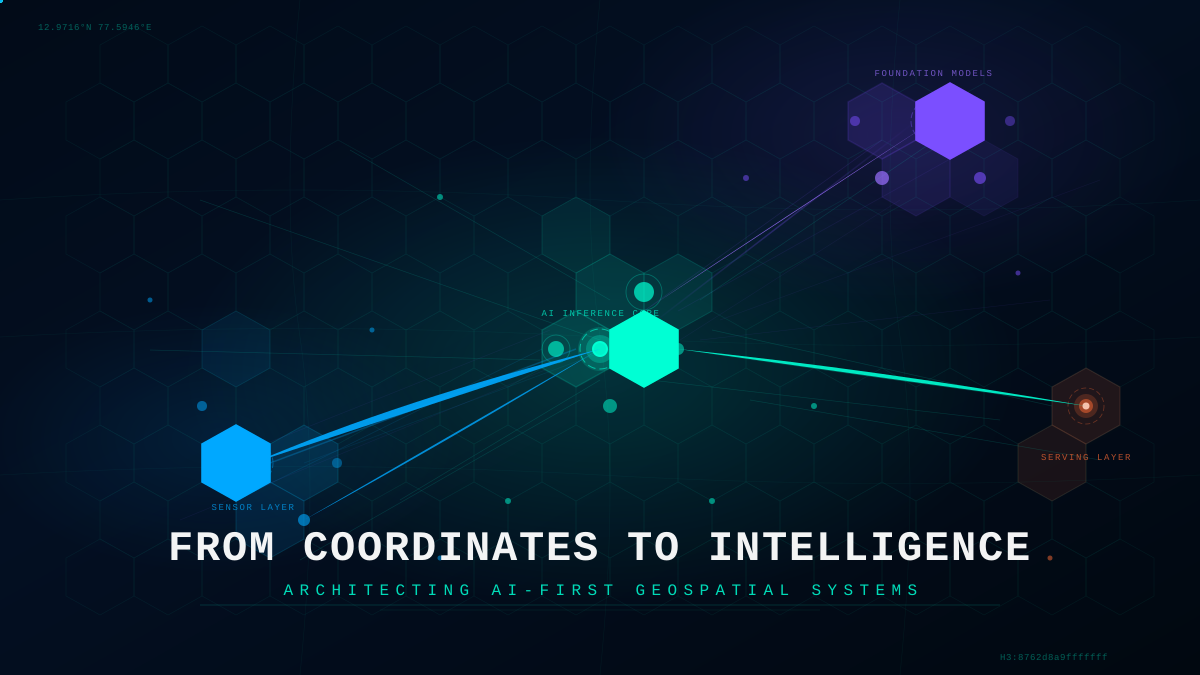
Architecting AI-First Geospatial Systems: From Coordinates to Intelligence
A technical deep-dive into designing geospatial platforms that treat AI as a first-class architectural citizen
Introduction
For most of the past four decades, geographic information systems (GIS) were built around a deceptively simple premise: capture the world as data, organize it into layers, and render it on a screen. The intelligence was human. The software was a sophisticated filing cabinet for spatial facts.
That model is dissolving.
The convergence of foundation models, spatiotemporal embeddings, real-time sensor networks, and cloud-native geospatial infrastructure has made it possible — and increasingly necessary — to architect systems where AI is not bolted on at the end but woven into every layer. We are moving from systems that answer “what is here?” to systems that reason about “what does this mean, what will happen next, and what should we do?”
This article explores the architectural principles, data strategies, and engineering patterns required to build geospatial systems that are genuinely AI-first — not AI-augmented.
1. Rethinking the Geospatial Data Model
From Geometries to Feature Graphs
Traditional GIS stores the world as geometries: points, lines, polygons, rasters. Relationships are inferred at query time through spatial joins. This works for human analysts navigating a map, but it creates a fundamental mismatch when AI systems need to reason across entities, relationships, and time simultaneously.
An AI-first geospatial system starts with a spatial knowledge graph rather than a layer stack. Entities — parcels, roads, buildings, administrative boundaries, sensor stations — exist as nodes with rich semantic attributes. Edges encode the relationships that matter: adjacency, containment, connectivity, causality, and temporal sequence. Spatial geometry becomes one property among many, not the primary organizing principle.
This shift has concrete engineering implications. Knowledge graphs for geospatial data typically combine:
- Property graphs (Neo4j, TigerGraph, or Amazon Neptune) for entity relationships
- Vector stores (pgvector, Weaviate, Pinecone) for semantic and learned embeddings
- Columnar spatial engines (DuckDB with spatial extensions, BigQuery, Snowflake) for analytical queries
- Streaming layers (Apache Kafka + Flink, or Redpanda) for real-time ingestion
The graph and the vector store are peers, not afterthoughts. Entities have both structured attributes and embedding representations, and queries can traverse both dimensions simultaneously.
Spatiotemporal Embeddings
The most consequential architectural decision in an AI-first geospatial system is how locations and regions are represented as vectors. Several approaches have emerged:
Tile-based encodings divide the globe into hierarchical grid cells — most notably Uber’s H3 hexagonal system and Google’s S2. These give every location a deterministic identifier at any resolution, enabling efficient spatial joins and aggregations without geometry computation. H3 is particularly well-suited for AI workloads because its hexagonal tessellation minimizes edge effects and makes neighborhood calculations uniform.
Learned place embeddings go further, training dense vector representations on co-occurrence patterns from GPS traces, geotagged content, or mobility data. A location’s embedding captures not just where it is but what kinds of activities, entities, and events are associated with it — a subway station and a shopping mall near each other may end up close in embedding space even if geometrically they occupy different polygons.
Foundation model geospatial encoders, exemplified by models like SatCLIP and GeoCLIP, learn representations from satellite imagery that encode semantic land use, vegetation patterns, built environment density, and other visual signals into a latent space where similar-looking places cluster together regardless of geographic distance. These representations transfer remarkably well to downstream tasks including crop yield prediction, disaster damage assessment, and urban growth modeling.
A robust AI-first platform maintains multiple embedding representations of the same spatial entities and routes queries to the appropriate representation based on the semantic intent of the request.
2. The AI Inference Stack for Geospatial Workloads
Spatial Foundation Models
The geospatial domain is building its own foundation models, trained on the kinds of data that general-purpose LLMs and vision models do not see at scale. Key categories include:
Remote sensing models such as IBM’s Prithvi (trained on HLS satellite time series), Microsoft’s Planetary Computer foundation models, and ESA’s Φ-lab models learn to extract semantic meaning from multispectral imagery across time. They understand the visual signature of flooding, urban heat islands, deforestation, and crop stress in ways that general vision models do not, because they have been trained on precisely these phenomena at global scale.
Trajectory and mobility models learn the grammar of movement — how vehicles, pedestrians, and vessels behave in space and time. Models pre-trained on billions of GPS traces can predict likely destinations, detect anomalous behavior, and classify transportation modes from raw coordinate sequences. This capability underlies applications ranging from urban traffic optimization to maritime surveillance.
Geospatial language models bridge the gap between natural language and spatial reasoning. Systems like NuExtract fine-tuned on geographic text, or retrieval-augmented systems that query spatial databases in response to natural language queries, allow non-expert users to interact with complex spatial data through conversation rather than query languages.
Inference Architecture Patterns
Deploying these models at geospatial scale — which frequently means processing continental or global extents at fine resolution — requires purpose-built inference infrastructure.
Tile-parallel inference is the dominant pattern for raster workloads. The spatial domain is partitioned into tiles (typically 256×256 or 512×512 pixels for imagery, or H3 resolution 7-9 cells for vector data), inference runs in parallel across thousands of compute nodes, and results are merged with attention to boundary artifacts. Cloud providers have invested heavily in this pattern: AWS SageMaker, Google Vertex AI, and Azure ML all support geospatially-aware distributed inference pipelines, with integrations to their respective geospatial data services (SageMaker Geospatial, Earth Engine, Planetary Computer).
Streaming inference for sensor networks requires a different architecture. Geospatial IoT — environmental sensors, traffic cameras, weather stations, AIS transponders, connected vehicles — generates continuous streams of spatially-indexed observations. Inference must happen at or near the sensor edge, with only anomalies or aggregates sent to the cloud. This demands lightweight model variants (quantized transformers, TinyML models, distilled versions of larger systems) deployed on edge hardware with spatial awareness baked into the processing pipeline.
Retrieval-augmented spatial reasoning combines the pattern-recognition capabilities of large models with precise factual grounding from spatial databases. When a user asks “which neighborhoods in this city are most vulnerable to flooding given the projected 2050 climate scenario?”, the system must retrieve current flood plain boundaries, elevation models, infrastructure locations, demographic data, and climate projections — then synthesize these into a coherent spatial analysis. The retrieval step is fundamentally spatial: it must locate, filter, and join data based on geographic relationships before passing it to the reasoning model.
3. Data Engineering for AI-First Geospatial Systems
The Spatial Lakehouse
The geospatial data engineering community has largely converged on the spatial lakehouse as the foundational data architecture. Building on open table formats — Apache Iceberg being the dominant choice, with Delta Lake as an alternative — the spatial lakehouse adds geospatial-aware partitioning, indexing, and query capabilities to a cloud object store.
The key innovations that make this AI-friendly are:
Spatial clustering and Z-ordering arrange data on disk according to spatial locality. Queries that filter by bounding box — which encompasses the vast majority of AI inference workloads — scan dramatically less data when rows with nearby coordinates are physically adjacent. Iceberg’s hidden partitioning, combined with Hilbert curve space-filling ordering, achieves near-optimal spatial locality without requiring users to understand partitioning internals.
Cloud-optimized raster formats — primarily Cloud Optimized GeoTIFF (COG) and the emerging GeoParquet standard — allow AI training pipelines and inference systems to read precisely the spatial subsets they need, without downloading entire files. A model training on global Sentinel-2 imagery can stream chips from the exact locations in its training set, in parallel, directly from S3 or GCS, without any data staging step.
Versioned spatial snapshots via Iceberg’s time-travel capability enable reproducible AI experiments. Geospatial data changes constantly — land cover evolves, administrative boundaries are redrawn, infrastructure is built and demolished. Without versioning, reproducing an analysis from eighteen months ago is effectively impossible. Iceberg preserves every historical state of the dataset, making temporal reproducibility a first-class property of the data layer.
Feature Engineering at Scale
AI models consume features, not raw coordinates. The pipeline from raw geospatial data to model-ready features involves several categories of transformation:
Spatial aggregations compute summary statistics over geographic units — average NDVI within a watershed, total impervious surface within a school catchment area, density of fast food restaurants within 800 meters of a parcel. These operations require spatial join capabilities at scale. Apache Sedona (formerly GeoSpark) and the spatial extensions in DuckDB and BigQuery handle this efficiently, but the data engineer must understand how to partition data to minimize shuffle and avoid Cartesian products.
Temporal feature engineering is essential for any geospatial AI application that involves change — which is most of them. Time-series features derived from satellite imagery (seasonal NDVI trajectories, land surface temperature anomalies), from sensor networks (traffic flow patterns, air quality cycles), or from mobility data (origin-destination matrices by hour of week) require careful handling of irregular time grids, missing observations, and varying spatial resolutions across time.
Cross-dataset spatial joins compose features from multiple sources — combining census socioeconomic data with OpenStreetMap amenity counts, satellite-derived land cover, and weather observations into a unified feature vector for each spatial unit. This requires robust entity resolution across datasets that may use different spatial references, temporal frequencies, and geographic identifiers.
4. Architecture Patterns and Reference Implementation
The Geospatial AI Platform Stack
A production AI-first geospatial system typically assembles the following layers:
Ingestion and collection handles data arriving from satellite downlink, sensor APIs, administrative data providers, and crowdsourced platforms. This layer must handle the impedance mismatch between batch bulk loads (full-coverage satellite imagery), micro-batch updates (hourly weather model outputs), and real-time streams (AIS vessel positions). A Kafka-based streaming backbone with connectors to S3 landing zones provides the flexibility to handle all three.
Storage and indexing organizes ingested data for efficient access. The spatial lakehouse (Iceberg on S3) serves as the source of truth for curated datasets. A spatial database (PostGIS on Aurora, or AlloyDB) supports low-latency transactional queries. A vector store holds learned embeddings for semantic search. A time-series database (InfluxDB, TimescaleDB, or QuestDB) handles high-frequency sensor data.
Feature and embedding services compute and serve derived features on demand. The feature store (Feast, Tecton, or a custom implementation on Redis + Iceberg) caches precomputed features for training and low-latency serving. The embedding service maintains up-to-date vector representations of spatial entities, regenerating them as underlying data changes.
AI orchestration manages the complexity of multi-model pipelines. Geospatial AI applications rarely rely on a single model — a typical pipeline might involve a change detection model, a classification model, an anomaly detection model, and a language model for report generation, all operating on different spatial scales and temporal resolutions. A workflow orchestrator (Apache Airflow, Prefect, or Dagster) with geospatial-aware task definitions coordinates these pipelines.
Serving and APIs expose AI capabilities to end users and downstream systems. Spatial AI APIs must support both traditional GIS queries (bounding box, polygon intersection) and semantic queries (find all areas similar to this reference location, explain the change in this region over the past year). A unified API gateway with spatial query parsing routes requests to the appropriate backend.
A Concrete Example: Urban Heat Island Detection and Prediction
Consider a system that continuously monitors urban heat islands across a metropolitan area, identifies neighborhoods at highest risk during extreme heat events, and recommends targeted interventions. This requires:
The data pipeline ingests Landsat 8/9 and Sentinel-3 land surface temperature imagery on a daily cadence, along with meteorological station observations and forecast model outputs, building stock data from a city GIS, tree canopy data from aerial LiDAR, and demographic data from the census.
The AI pipeline runs a change detection model to flag anomalous temperature signatures, a regression model to predict next-72-hour peak temperatures at the census-block level given weather forecast inputs, a clustering model to identify neighborhoods with similar heat exposure profiles, and a language model fine-tuned on urban heat intervention literature to recommend actions based on the neighborhood characteristics and heat profile.
The serving layer exposes these capabilities as a map-based dashboard for city planners, a REST API for integration with the city’s emergency management system, and a conversational interface that allows non-technical staff to query the system in natural language (“which senior-majority neighborhoods will see temperatures above 38°C this weekend?”).
Each component makes specific architectural choices that enable the AI capabilities: cloud-optimized storage for fast imagery access, spatiotemporal embeddings that capture seasonal patterns, a feature store that pre-computes building and canopy density at multiple spatial scales, and a retrieval system that grounds the language model’s recommendations in verified geospatial facts rather than parametric knowledge alone.
5. Engineering Challenges and Tradeoffs
Scale and Latency
Geospatial AI systems face an inherent tension between the global scale of their data and the local specificity of their queries. A model trained on continental imagery must make inferences about individual parcels. A platform serving millions of simultaneous users must make spatial queries that touch petabytes of indexed data. Resolving this tension requires aggressive use of spatial indexing (R-trees, quadtrees, H3 hierarchies), multi-resolution data pyramids, and caching strategies that account for the spatial locality of user queries.
Coordinate Reference Systems
CRS handling remains a source of subtle but consequential bugs in geospatial AI systems. Models trained on WGS84 coordinates do not automatically generalize to projected coordinate systems, and the choice of map projection affects the geometric properties — distances, areas, angles — that machine learning models implicitly rely on. An AI-first system must enforce CRS consistency throughout the data pipeline and make projection decisions deliberately, choosing equal-area projections for density analyses, conformal projections for navigation applications, and equidistant projections when distance accuracy matters.
Temporal Alignment
Multi-source geospatial datasets rarely share the same temporal cadence. Satellite imagery may arrive weekly, weather forecasts every six hours, sensor readings every minute, and administrative boundaries only when they change. Combining these for AI training requires careful temporal alignment — deciding how to handle gaps, how to interpolate missing observations, and how to represent temporal uncertainty to the model.
Model Interpretability in High-Stakes Applications
Geospatial AI increasingly supports high-stakes decisions: disaster response, urban planning, environmental regulation enforcement, and public health interventions. Decision-makers in these domains are rightly skeptical of black-box recommendations. Architectures that support spatial interpretability — attention maps on imagery, SHAP values for feature contributions, uncertainty quantification over geographic space, and counterfactual explanations — are increasingly important for adoption. This is not a cosmetic concern; in many regulatory contexts, it is a legal requirement.
6. The Emerging Standards Landscape
The geospatial AI field is developing standards that will shape architecture decisions for years to come:
OGC API – Processes defines a web standard for exposing geospatial processing workflows as HTTP services, making it possible to compose AI analysis steps with traditional GIS operations in a standards-compliant way. Several leading GIS vendors and cloud providers are implementing this standard, which promises better interoperability between AI systems and existing geospatial infrastructure.
STAC (SpatioTemporal Asset Catalog) has rapidly become the de facto standard for cataloging geospatial datasets, particularly satellite imagery. Its JSON-based metadata model, combined with the STAC API specification, enables AI training pipelines to discover, filter, and access geospatial datasets from any compliant catalog without custom data connectors.
GeoParquet is standardizing the representation of vector geospatial data in the Apache Parquet columnar format, enabling geospatial data to participate fully in the modern data lakehouse ecosystem. As GeoParquet adoption grows, the friction of integrating geospatial data into ML pipelines will continue to decrease.
ML Model Cards with Spatial Context — an emerging practice rather than a formal standard — extends the model card framework to document the geographic scope, spatial resolution, temporal range, and known geographic biases of AI models trained on geospatial data. A model trained primarily on North American or European imagery may perform poorly in other regions; documenting this is essential for responsible deployment.
Conclusion
The transition from coordinate-centric GIS to intelligence-centric geospatial systems is not a product cycle — it is an architectural paradigm shift. The systems that will define this decade in the geospatial domain are being designed today, and the choices made at the architectural level will determine whether AI capabilities are genuine first-class citizens or expensive ornaments on legacy foundations.
The core principles are consistent across application domains: represent the world as a knowledge graph enriched with learned embeddings, design data pipelines that preserve temporal history and support reproducible AI experiments, build inference infrastructure that scales from global extents to parcel-level resolution, and invest in interpretability from the start rather than retrofitting it under pressure.
Geospatial data is among the richest and most consequential data humans have ever generated. We have mapped nearly every surface feature of this planet from orbit, instrumented cities with billions of sensors, and accumulated decades of historical imagery capturing the evolution of landscapes, ecosystems, and human settlements. The opportunity before geospatial engineers is to build systems that can actually reason over this wealth — systems that transform coordinates into comprehension, and maps into intelligence.
This article reflects the state of geospatial AI architecture as of early 2026. The field is evolving rapidly; readers are encouraged to consult current documentation for the specific tools and models mentioned.