
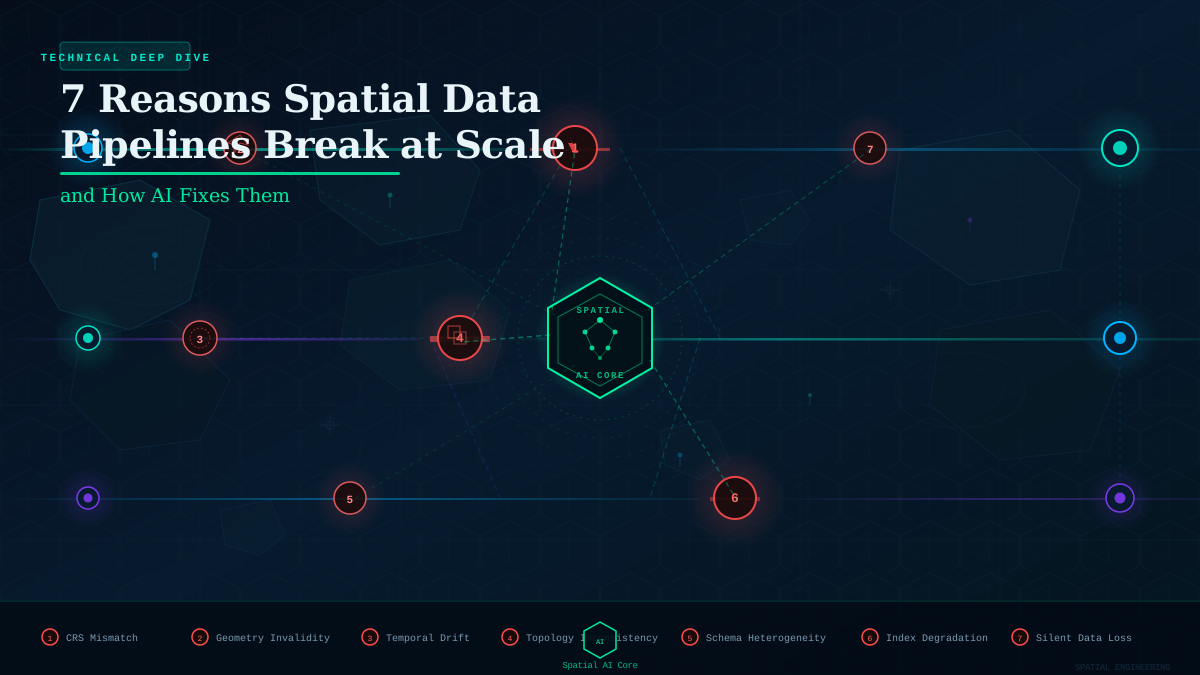
7 Reasons Why Spatial Data Pipelines Break at Scale (and How AI Fixes Them)
A technical deep-dive for GIS engineers, data architects, and spatial analytics teams
Spatial Data Pipelines
Spatial data pipelines are among the most fragile constructs in modern data engineering. They sit at the intersection of geometry, topology, coordinate reference systems, time, and ever-changing real-world features — all of which conspire to make them brittle at scale. What works perfectly for a few thousand records will collapse under millions. What runs cleanly in a dev environment will corrupt silently in production.
The promise of AI in this domain is not simply automation — it’s intelligent, adaptive fault tolerance. AI systems can learn failure patterns, catch anomalies that rule-based validators miss, and repair data with contextual awareness that no hardcoded script can replicate. But to understand why that matters, you first need to understand where spatial pipelines break.
Here are the seven most common failure modes, and how modern AI approaches address each of them.
1. Coordinate Reference System (CRS) Mismatches
Of all the ways a spatial pipeline can fail, CRS confusion is simultaneously the most common and the most catastrophic. Two datasets that appear to share the same geographic space will diverge by thousands of kilometers when they carry incompatible projections. Worse, many pipelines accept geometries without explicit CRS metadata, creating silent corruption that propagates for days before anyone notices a spatial join returning an empty result set.
At scale, this problem compounds. Pipelines ingesting from dozens of heterogeneous sources — government shapefiles, vendor APIs, satellite imagery providers, IoT telemetry — each have their own CRS conventions. A dataset tagged EPSG:4326 by one vendor might mean longitude-latitude, while another uses the same tag but delivers latitude-longitude. Some providers use deprecated EPSG codes that map to subtly different datums. Manual curation of CRS handling rules doesn’t scale past a handful of sources.
How AI fixes it: Machine learning models trained on large corpora of geospatial datasets can perform CRS inference from coordinate ranges, geometry distributions, and contextual metadata — even in the absence of explicit projection tags. Techniques like coordinate range fingerprinting (recognizing that values between −180/180 and −90/90 suggest WGS84, while values in the millions suggest a projected system) combined with source-context embeddings allow AI systems to assign CRS with high confidence and flag ambiguous cases for review rather than silently corrupting data. Some production systems now use neural classifiers that achieve over 95% accuracy in CRS inference from raw geometry alone.
2. Geometry Invalidity at High Volume
Geometry validity is governed by formal rules derived from the OGC Simple Features specification: polygons must have closed rings, self-intersections are forbidden in simple geometries, rings must be oriented correctly, and multi-part geometries must not overlap their own sub-parts. In small datasets, these violations are easy to catch and repair manually. At scale, they become a statistical certainty.
Consider a pipeline processing building footprints for an entire country — tens of millions of polygons sourced from cadastral systems, aerial digitization, and crowdsourced platforms. Even a 0.1% invalidity rate means hundreds of thousands of broken geometries. These propagate downstream into spatial indexes that cannot be built correctly, intersection operations that throw exceptions or return nonsense, and area calculations that silently produce negative values.
The conventional fix — running ST_MakeValid or GEOS repair functions on everything — is expensive and often produces geometrically correct but semantically wrong results. A bowtie polygon repaired by splitting produces two smaller polygons where one feature existed, breaking all downstream joins on feature identity.
How AI fixes it: AI-driven geometry repair goes beyond syntactic validity to semantic plausibility. By training on representative samples of valid geometries for a given feature class — buildings, parcels, road buffers — a model learns what a reasonable geometry for that class looks like. It can then distinguish between a polygon with a minor vertex error (best repaired by snapping) versus a fundamentally malformed digitization (best flagged for re-capture). Graph neural networks operating on polygon vertex sequences have shown strong performance in classifying invalidity type before repair is attempted, dramatically improving the quality of automated corrections.
3. Temporal Drift and Feature Currency
Spatial data has a timestamp problem that tabular data does not. A customer’s mailing address changes, and the change is discrete — there was an old address, now there is a new one. But a road network changes continuously and partially. A new interchange opens while adjacent roads are still under construction. A river shifts its channel. A land use classification changes for part of a parcel but not all of it. Keeping a spatial dataset synchronized with the real world is not a simple update operation — it’s a continuous reconciliation problem.
Pipelines that ingest spatial data from multiple update cycles without proper temporal alignment introduce ghost features (geometries that no longer exist in reality), zombie features (real features not yet reflected in the data), and topology inconsistencies at update boundaries. A road segment that was split in one update cycle but whose attributes were updated in a prior cycle will appear to carry the wrong speed limit or classification.
How AI fixes it: AI-powered change detection, particularly when combined with satellite or aerial imagery, can identify real-world changes that have not yet propagated into vector datasets. Models trained on multitemporal imagery learn the visual signatures of construction, demolition, land clearing, and hydrological change, triggering automated pipeline refresh for affected areas rather than waiting for scheduled bulk updates. Within the pipeline itself, temporal graph models can detect feature lifecycle anomalies — a feature that appears, disappears, and reappears is likely a merge/split artifact rather than a real-world event — and apply appropriate lineage tracking. The result is a pipeline that is aware of what it doesn’t know and can prioritize data refresh intelligently.
4. Topological Inconsistency Across Dataset Boundaries
Spatial datasets from different producers are almost never topologically consistent with each other. Administrative boundaries from a national statistics office will not perfectly align with the same boundaries as represented in a road network dataset. Parcel boundaries from a county assessor will not perfectly close against each other — there will be slivers, gaps, and overlaps at the seams. When these datasets are combined in a spatial pipeline — for example, to apportion demographic statistics to custom zones, or to route around regulated land areas — the topological inconsistencies generate spurious spatial relationships and corrupt aggregations.
At scale, this problem is amplified by the sheer number of boundary interactions. A pipeline joining a nationwide parcel dataset to census blocks must handle millions of polygon-on-polygon relationships, and even tiny misalignments produce sliver polygons that pollute area-weighted averages and count-based aggregations. Traditional solutions — buffering, tolerancing, snap-to-grid — are blunt instruments that often fix one inconsistency while creating another.
How AI fixes it: AI approaches to topological harmonization treat boundary alignment as a learned optimization problem. Given pairs of overlapping datasets, a model learns the characteristic offset patterns and scale discrepancies between producers — for instance, that a particular state’s road centerlines consistently sit 2–5 meters east of the corresponding parcel boundary due to differing GPS collection epochs. Rather than applying a uniform snap tolerance, the model applies spatially varying corrections derived from the local alignment pattern, preserving topology at known good boundaries while correcting at known bad ones. This is particularly powerful when combined with authoritative reference datasets as alignment anchors.
5. Schema and Attribute Heterogeneity
Spatial pipelines that aggregate data across organizations and jurisdictions face an attribute integration problem that dwarfs anything in standard ETL. A “road classification” field might carry values of “motorway”, “M-class”, “Interstate”, “Primary”, “Class 1”, “A-road”, or numeric codes — all meaning roughly the same thing but in incompatible vocabularies. Population counts might be stored as integers in one source and floating-point estimates with confidence intervals in another. Address components might be fully parsed in one dataset and stored as a single unstructured string in another.
At scale, the combinatorial explosion of schema mismatches makes manual mapping tables unworkable. A pipeline integrating land use data from 3,000 county-level sources — each with its own classification system — cannot be maintained through handcrafted crosswalk tables that engineers update manually. The tables become stale, edge cases multiply, and the pipeline degrades silently as new jurisdictions are added.
How AI fixes it: Large language models with geospatial domain fine-tuning excel at schema harmonization. By treating attribute mapping as a semantic similarity problem rather than a string matching problem, LLM-powered schema reconciliation can correctly equate “Residential Single Family Detached” with “R-1 Residential” with “Single Unit Residential” without an explicit mapping rule for that pair. More importantly, such models can generate probabilistic confidence scores for each mapping, allowing the pipeline to auto-accept high-confidence harmonizations while routing low-confidence cases to a human-in-the-loop review queue. Applied iteratively, this creates a pipeline that becomes more robust with each new jurisdiction it encounters.
6. Spatial Index Degradation and Query Planning Failures
Spatial databases rely on indexes — R-trees, quadtrees, space-filling curve encodings — to make proximity queries tractable. These indexes are built on assumptions about data distribution: they work well when geometries are roughly uniformly distributed across space. Real-world spatial data violates this assumption constantly. Urban areas have orders of magnitude higher feature density than rural areas. Coastlines have radically different geometry complexity than flat plains. When spatial indexes are built naively on highly skewed data, query planning fails catastrophically — the optimizer chooses a sequential scan over an index scan because the index statistics don’t reflect the true distribution, or it chooses an index scan that performs worse than a sequential scan because the bounding boxes in a dense urban cluster overlap almost completely.
At scale, these failures manifest as queries that worked in staging — where data was spatially clipped to a manageable region — suddenly running for hours in production against the full dataset. The pipeline appears to hang. Timeouts cascade. Downstream consumers see stale data or no data at all.
How AI fixes it: AI-driven query planning for spatial workloads treats index selection and partition strategy as a learned optimization problem. Reinforcement learning agents trained on query execution logs learn to recognize the spatial distribution signatures that predict poor index performance, and proactively recommend or trigger re-partitioning, statistics refresh, or auxiliary index construction. More sophisticated systems apply learned cost models that account for geometry complexity (a polygon with 10,000 vertices is not comparable to one with 4, even if their bounding boxes are similar) in ways that standard database statistics cannot capture. The result is spatial query performance that remains stable as data volume and distribution evolve, rather than degrading unpredictably.
7. Silent Data Loss at Scale Boundaries
Perhaps the most insidious failure mode is the one that produces no error — just quietly wrong results. Spatial pipelines that process data in parallel tiles or chunks must handle features that cross tile boundaries. A standard tiling approach clips features at tile edges, processes each tile independently, and then attempts to reassemble. At small scale, the seam artifacts are minor and often invisible. At large scale — processing a continental road network, a national building footprint dataset, a global maritime boundary layer — the seam artifacts accumulate into systematic errors: road segments that don’t connect at tile boundaries, polygons that have been split into fragments with different attributes, topology violations introduced precisely at the edges where tiles were joined.
Similar silent failures occur in coordinate precision handling. Operations that cast geometries to lower-precision types for performance reasons introduce rounding errors that accumulate through a processing chain. A pipeline that seems to work correctly on a single machine may silently lose sub-meter precision when distributed across nodes that use different internal representations.
How AI fixes it: AI-powered pipeline monitoring treats silent data loss as an anomaly detection problem. By learning statistical signatures of healthy pipeline output — expected feature count distributions by region, expected geometry complexity distributions by feature class, expected connectivity ratios for network datasets — a monitoring model can detect when tile boundary artifacts have corrupted an output region without requiring explicit validation rules for every possible failure mode. When degradation is detected, the system can trigger targeted re-processing of affected areas with adjusted parameters, or flag specific tile boundaries for seam-repair post-processing. For precision loss, learned data quality profiles establish expected precision envelopes for each dataset, flagging outputs that fall outside those envelopes before they propagate downstream.
The Common Thread: From Rules to Reasoning
The seven failure modes above share a common characteristic: they are all cases where rule-based approaches eventually fail because the rules cannot be made comprehensive enough to cover the full variability of real-world spatial data at scale. Every rule has an exception. Every exception requires a new rule. Eventually the rule set becomes unmaintainable and the pipeline becomes brittle.
AI approaches are not magic replacements for sound pipeline engineering. Spatial data pipelines still need proper CRS handling, geometry validation, topology management, and schema design. But AI adds a layer of adaptive reasoning that sits above the rules — learning from the data itself what “normal” looks like, detecting deviations that no rule anticipated, and applying contextually appropriate corrections rather than blunt global fixes.
The practical path forward for most geospatial engineering teams is not to replace existing pipeline infrastructure with AI-native systems overnight, but to identify the two or three failure modes that cause the most operational pain — the ones that wake engineers up at night, that require the most manual intervention, that produce the most downstream complaints — and apply targeted AI-driven solutions there first. The gains are typically fastest at the validation and anomaly detection layer, where AI monitoring can be added to existing pipelines without re-engineering the processing logic.
Spatial data will only grow more complex, more voluminous, and more heterogeneous. The pipelines that survive at scale will be the ones that can reason about their own failures — and that requires a degree of intelligence that rules alone cannot provide.
This article covers spatial data pipeline engineering for production GIS and geospatial analytics systems. The AI approaches referenced reflect techniques currently in use across enterprise geospatial platforms and academic spatial computing research.
