
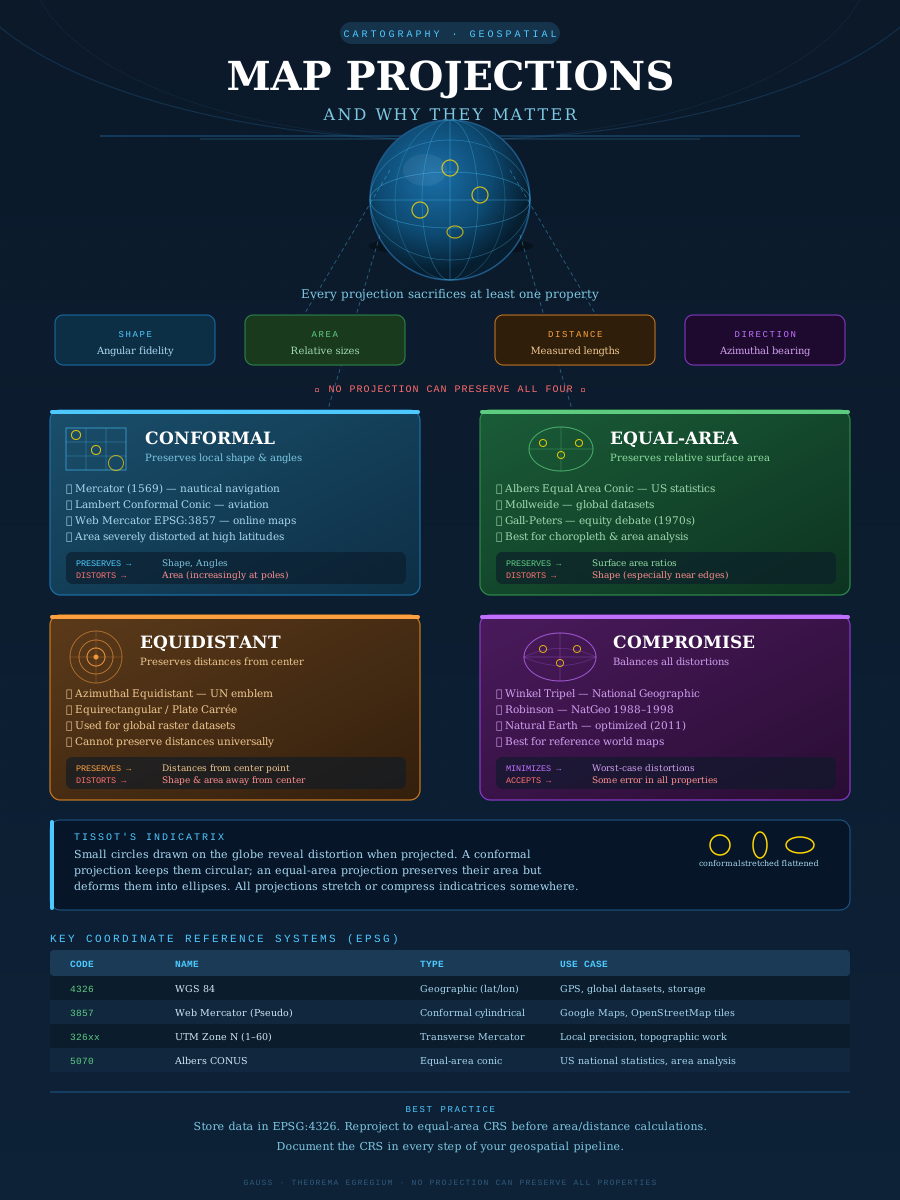
What Is a Map Projection: and Why Does It Matter?
A Technical Overview of Cartographic Projection Systems
Geospatial Technology · Cartography · Data Visualization
Introduction
Every map you have ever seen — from a paper road atlas to a satellite navigation display — is a lie. Not a malicious one, but an inevitable geometric compromise. The Earth is a three-dimensional oblate spheroid; a flat map is two-dimensional. No matter how skilled the cartographer, some property of the real world must be sacrificed in the translation. The mathematical rules governing how points on the sphere are transformed into points on the plane are collectively known as map projections, and understanding them is foundational to anyone working with geographic data.
This article explains what map projections are, surveys the major families of projections, describes the distortions each introduces, and outlines the practical implications for developers, data scientists, and analysts who work with geospatial information.
The Core Problem: Flattening a Sphere
Imagine peeling an orange and trying to press the skin flat on a table. You will inevitably tear the peel or create folds and overlaps. Cartographers face the same challenge. The surface of a sphere has a property called Gaussian curvature — it curves in two directions simultaneously. A flat surface has zero curvature. Because these two surfaces are fundamentally incompatible, any map projection must distort at least one of the following four properties:
- Shape (conformal/angular fidelity): Are local angles and shapes preserved?
- Area (equal-area/equivalent fidelity): Are relative sizes of regions preserved?
- Distance (equidistant fidelity): Are distances from a given point or along given lines preserved?
- Direction (azimuthal fidelity): Are bearings from a central point preserved?
| Tissot’s Indicatrix: Cartographers use small circles (indicatrices) drawn on a globe. When projected, a perfectly conformal projection keeps them as circles; an equal-area projection keeps their areas constant but may deform them into ellipses; other projections do both, revealing the nature and magnitude of distortion across the map. |
No single projection can preserve all four properties simultaneously — a mathematical theorem known as Gauss’s Theorema Egregium (Remarkable Theorem) guarantees this impossibility. Every projection is therefore a deliberate trade-off.
The Projection Process
A map projection is formally defined as a function f: (φ, λ) → (x, y), where φ is geographic latitude, λ is longitude, and (x, y) are Cartesian coordinates on the map plane. The projection may be derived geometrically, by imagining a light source casting shadows from the globe onto a surface, or analytically, by mathematical equations developed to satisfy specific geometric properties.
Projection Surfaces
Projections are often classified by the intermediate surface onto which the globe is conceptually projected before being unrolled flat:
- Cylindrical projections wrap a cylinder around the globe (tangent or secant). When unrolled, they produce rectangular maps with parallel meridians and parallels. The Mercator and Universal Transverse Mercator (UTM) are cylindrical.
- Conic projections place a cone over the globe, touching it along one or two standard parallels. They work well for mid-latitude regions with east-west extent. Albers Equal Area Conic and Lambert Conformal Conic are common examples.
- Azimuthal (planar) projections project onto a flat plane touching the globe at a single point. They preserve directions from the center point and are commonly used for polar maps. The stereographic and gnomonic projections fall into this category.
Aspect
The aspect describes the orientation of the projection surface relative to the globe. A normal (equatorial) cylindrical projection has its axis aligned with the Earth’s rotation axis. A transverse projection rotates the surface 90°, while an oblique projection uses an intermediate angle. The choice of aspect shifts the zone of minimum distortion to the region of interest.
Major Projection Families and Their Properties
Conformal Projections
A conformal projection preserves local angles, meaning that the shape of small features is accurate, even though large-scale shapes are distorted. Meridians and parallels always cross at right angles. Conformal projections cannot be equal-area.
Mercator (1569): The canonical conformal cylindrical projection. Straight lines on a Mercator map are lines of constant bearing (rhumb lines), making it invaluable for nautical navigation. The trade-off is severe area distortion at high latitudes — Greenland appears roughly the same size as Africa, despite being about 14 times smaller in reality. The web mapping industry adopted a spherical variant called Web Mercator (EPSG:3857) for tile-based mapping services.
Lambert Conformal Conic: Preserves shape over large mid-latitude regions. Used extensively for aeronautical charts because straight lines closely approximate great-circle routes over short distances.
Equal-Area Projections
Equal-area (equivalent) projections preserve the relative areas of all regions. A country occupying 2% of the Earth’s land area will occupy 2% of the map’s surface. Shape must be sacrificed to achieve this.
Albers Equal Area Conic: Widely used for statistical maps of the contiguous United States because it avoids the misleading impression that sparsely populated western states dominate national data.
Mollweide and Goode’s Homolosine: Whole-world equal-area projections. Goode’s interrupted design reduces shape distortion by introducing cuts in the oceans or continents, resembling a peeled orange skin.
Peters/Gall-Peters: A cylindrical equal-area projection that attracted controversy in the 1970s and 1980s when promoted as a politically equitable alternative to Mercator, which was argued to inflate the apparent size of northern hemisphere nations. The debate brought cartographic literacy to a wider audience.
Equidistant Projections
Equidistant projections preserve distances from one or two specific points or along specific lines, but cannot preserve distances in general across the map.
Azimuthal Equidistant: Distances and directions from the center point are accurate. The United Nations emblem famously uses this projection centered on the North Pole.
Equirectangular (Plate Carrée): The simplest projection — latitude and longitude are mapped directly to y and x coordinates. Easy to implement, but distortion increases rapidly toward the poles. Commonly used for global raster datasets and satellite imagery.
Compromise Projections
Some projections sacrifice strict adherence to any single property in exchange for a visually pleasing whole-world representation that minimizes the worst distortions.
Robinson: Used by National Geographic from 1988 to 1998, it neither preserves area nor shape perfectly but distributes distortion more evenly. Developed by Arthur Robinson by specifying desired visual appearance first, then fitting equations to it — an unusual inversion of the usual design process.
Winkel Tripel: The current National Geographic standard. Its name refers to minimizing three types of distortion simultaneously. It outperforms most competitors on overall distortion metrics.
Natural Earth: A pseudocylindrical projection developed in 2011, optimized through software-based optimization to achieve a balanced, natural-looking appearance for small-scale world maps.
Coordinate Reference Systems
A Coordinate Reference System (CRS) combines a projection with a geodetic datum — the mathematical model of the Earth’s shape and orientation — plus units and an origin. When working with geospatial data, matching CRS is as important as matching units in physics. Mixing CRS without reprojection produces incorrect spatial relationships and calculations.
| Key EPSG Codes to Know EPSG:4326 — WGS 84 geographic coordinates (latitude/longitude). Used by GPS and most global datasets. EPSG:3857 — Web Mercator. Used by Google Maps, OpenStreetMap, and tile-based web mapping. EPSG:32601–32660 / 32701–32760 — UTM zones North/South. Used for local engineering and precision work. EPSG:5070 — Albers Equal Area Conic for the contiguous United States. Preferred for US-wide area calculations. |
The UTM System
The Universal Transverse Mercator system divides the Earth into 60 north-south zones, each 6° of longitude wide. Within each zone, a transverse Mercator projection keeps distortion below 1 part in 1,000, making UTM suitable for large-scale topographic and engineering work. UTM coordinates are expressed in metres east of a central meridian (easting) and north or south of the equator (northing).
Why Map Projections Matter in Practice
Area and Distance Calculations
Calculating the area of a polygon or the distance between two points in a geographic information system (GIS) depends critically on the projection. Performing these calculations in geographic (lat/lon) coordinates using Euclidean formulas treats degrees as if they were uniform units of length — a serious error, since a degree of longitude near the equator covers about 111 km but near a pole covers nearly nothing. Using an inappropriate projected CRS introduces systematic bias in area estimates used for environmental modelling, urban planning, epidemiology, and resource allocation.
Spatial Joins and Overlay Analysis
When two datasets use different projections, a spatial join — determining which features overlap or are nearby — will produce wrong results or fail silently. Libraries such as PostGIS, GDAL, GEOS, and Shapely will perform calculations in whatever coordinates are provided, without checking whether the coordinates are in a sensible CRS for the operation. The responsibility for ensuring CRS consistency falls on the analyst.
Machine Learning and Computer Vision
Training object detection models on satellite imagery requires understanding that pixels do not represent equal areas across a scene projected in Web Mercator. At high latitudes, pixels represent much larger ground areas than at the equator. Models trained without accounting for this scale variation may exhibit geographic bias. Similarly, generating synthetic training data from geographic datasets requires projecting to an appropriate equal-area CRS before sampling.
Data Visualization and Perception
Choropleth maps — where regions are colored according to a statistical variable — should nearly always use equal-area projections. Using a conformal or compromise projection inflates large, often sparsely populated regions, creating a perceptual bias. A density map of COVID-19 cases in Web Mercator would make Canada and Russia appear to dominate global totals simply due to their inflated visual size at high latitudes.
Navigation and Routing
The shortest path between two points on Earth is a great-circle route, which is a straight line on a gnomonic projection but a curve on a Mercator map. Rhumb-line routes (constant bearing) appear straight on Mercator but are longer than great-circle routes. Aviation and maritime routing systems must account for this distinction, particularly on transoceanic paths.
Selecting the Right Projection
Projection selection should be driven by the purpose of the map or analysis. A practical framework:
- Measuring or comparing areas → use an equal-area projection appropriate to the geographic scope (e.g., Albers for the US, Mollweide for global).
- Navigation and bearing → use a conformal projection (Mercator for sea, Lambert Conformal Conic for air).
- Local high-precision work → use UTM or a national grid system.
- General reference world maps → use a compromise projection (Winkel Tripel, Natural Earth).
- Web tile mapping → Web Mercator (EPSG:3857) is the de facto standard, but switch to an appropriate projection for any server-side analysis.
- Polar regions → azimuthal projections centered on the pole.
| Best Practice for Geospatial Analysis: Store your data in geographic coordinates (EPSG:4326) for interoperability, but always reproject to an appropriate equal-area or equidistant CRS before performing area, distance, or buffer calculations. Document the CRS in your data pipeline metadata. |
Map Projections in the Modern Geospatial Stack
Modern geospatial libraries such as PROJ (the de facto standard C library for coordinate transformations), pyproj (its Python wrapper), GDAL, and GeoServer handle the mathematical complexity of reprojection automatically, given correct EPSG codes or PROJ strings. The challenge has shifted from computation to awareness — knowing that projections matter and specifying them correctly.
Cloud-native formats such as Cloud Optimized GeoTIFF (COG) and GeoParquet include CRS metadata in their headers. Tooling built on Apache Arrow and DuckDB is increasingly aware of geospatial semantics. As geospatial analysis moves into data science workflows, projection literacy becomes an expected competency alongside data cleaning and statistical modelling.
Conclusion
Map projections are not a historical curiosity; they are an active source of error and misinterpretation in geospatial work. Every projection embodies a trade-off among shape, area, distance, and direction — and the right choice depends entirely on the task at hand. A navigation chart, a thematic statistical map, and a machine learning training dataset each call for a different approach.
The mathematician’s guarantee that a sphere cannot be flattened without distortion is non-negotiable. The cartographer’s skill — and the data scientist’s responsibility — lies not in eliminating distortion but in choosing which distortion is acceptable for the purpose, and communicating that choice transparently to the audience.
Understanding map projections means understanding the fundamental limitations of any two-dimensional representation of our three-dimensional world — and making informed decisions about those limitations rather than ignoring them.
Further Reading
Snyder, J.P. (1987). Map Projections — A Working Manual. US Geological Survey Professional Paper 1395.
Battersby, S.E. (2009). The Effect of Global-Scale Map Projection Knowledge on Perceived Land Area. Cartographica, 44(1).
Maling, D.H. (1992). Coordinate Systems and Map Projections (2nd ed.). Pergamon Press.
PROJ Documentation: https://proj.org/operations/projections/
EPSG Geodetic Parameter Registry: https://epsg.org/