
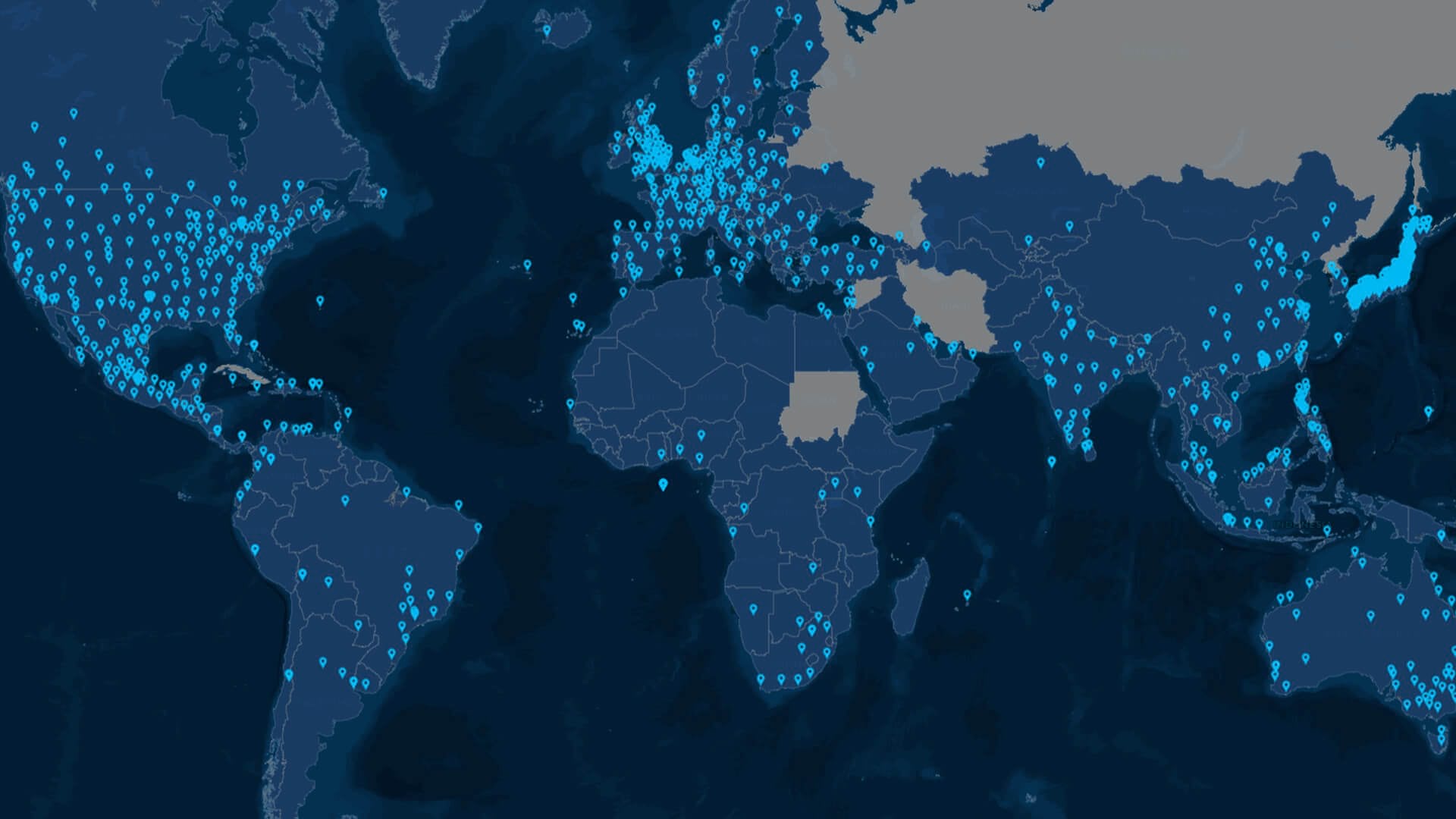
For large enterprises, data alone is no longer a differentiator. Competitive advantage increasingly comes from how quickly and clearly data can be turned into decisions. This is where location intelligence plays a critical role. By combining geographic context with business data, Fortune 500 companies gain insights that are faster, more intuitive, and often impossible to uncover through spreadsheets or charts alone.
Location intelligence is not about maps for decoration. It is about seeing patterns, risks, and opportunities through geography—and using that perspective to outperform competitors.
Why Location Intelligence Matters at Enterprise Scale
Fortune 500 organizations operate across hundreds of cities, regions, and countries. Their challenges are inherently spatial:
- Where to open or close facilities
- How to optimize supply chains
- Which markets to prioritize
- How regional behavior differs
- Where risks are concentrated
Traditional dashboards often flatten these realities into rows and columns. Location intelligence restores the missing dimension: where. When executives can see performance, demand, and risk geographically, decision-making becomes faster and more confident.
Strategic Market Expansion and Site Selection
One of the most common uses of location intelligence among large enterprises is market expansion. Choosing where to invest next is a high-stakes decision involving demographics, income levels, competition, infrastructure, and regulation.
Fortune 500 companies use location intelligence to:
- Overlay demographic and economic data
- Identify underserved or high-growth regions
- Compare potential locations side by side
- Simulate future scenarios based on infrastructure or policy changes
Instead of relying on intuition or static reports, leadership teams can visually evaluate options and quickly narrow down the most promising markets.
Optimizing Supply Chains and Logistics Networks
Supply chains are fundamentally geographic systems. Manufacturing plants, warehouses, ports, suppliers, and customers are all distributed across space. Even small inefficiencies compound at enterprise scale.
Location intelligence helps companies:
- Visualize end-to-end supply networks
- Identify bottlenecks and single points of failure
- Optimize routing and distribution hubs
- Assess proximity to suppliers and customers
- Model disruption scenarios such as weather, geopolitical risk, or infrastructure failures
By seeing supply chains on maps rather than lists, executives can identify vulnerabilities and optimization opportunities that might otherwise remain hidden.
Improving Sales Territory and Performance Management
For large sales organizations, territory design is a constant challenge. Poorly balanced territories lead to lost revenue, internal friction, and underperformance.
Fortune 500 sales teams use location intelligence to:
- Design territories based on geography, not just accounts
- Balance workload and revenue potential
- Visualize customer density and opportunity gaps
- Track regional performance trends in real time
Maps allow sales leaders to spot over-served or under-served areas quickly and adjust strategies before problems escalate.
Retail Network Optimization and Customer Proximity
For enterprises with physical locations—stores, branches, service centers—location intelligence is indispensable. Decisions about openings, closures, and refurbishments depend heavily on geographic context.
Companies use location intelligence to:
- Analyze footfall and catchment areas
- Measure cannibalization between nearby locations
- Understand customer travel patterns
- Compare performance across regions and cities
By aligning store networks with how customers actually move and behave, enterprises improve profitability and customer experience simultaneously.
Risk Management and Resilience Planning
Risk rarely distributes evenly. Natural disasters, regulatory changes, political instability, and infrastructure constraints all have geographic footprints.
Fortune 500 risk and compliance teams rely on location intelligence to:
- Map exposure to environmental and climate risks
- Identify facilities or suppliers in high-risk zones
- Monitor regulatory differences across regions
- Prepare contingency plans geographically
This spatial awareness allows enterprises to shift from reactive crisis management to proactive resilience planning.
Mergers, Acquisitions, and Portfolio Analysis
During mergers and acquisitions, speed and clarity are crucial. Location intelligence helps decision-makers rapidly understand how assets and operations overlap geographically.
Common use cases include:
- Identifying redundant facilities
- Spotting expansion opportunities through combined footprints
- Assessing geographic concentration risk
- Evaluating regional synergies
Maps often surface insights in minutes that would take days to uncover through traditional analysis.
Executive Communication and Boardroom Decisions
At the Fortune 500 level, communication clarity is as important as analytical depth. Board members and senior executives do not have time to interpret complex datasets.
Location intelligence supports executive decision-making by:
- Summarizing complex data visually
- Highlighting regional contrasts instantly
- Supporting strategic narratives with geographic evidence
- Reducing explanation time during presentations
A well-designed map can replace multiple slides of charts and tables, accelerating alignment and approvals.
From Static Maps to Interactive Intelligence
Modern Fortune 500 organizations are moving beyond static maps to interactive, layered geographic platforms. These allow users to:
- Drill down from global to local views
- Toggle data layers dynamically
- Explore scenarios without rebuilding reports
- Share insights across departments
This interactivity democratizes access to geographic insight, enabling faster decisions across the organization—not just at the top.
Building a Sustainable Competitive Advantage
What sets Fortune 500 companies apart is not just access to data, but their ability to integrate insights into daily operations. Location intelligence becomes a competitive advantage when it is:
- Embedded into workflows
- Trusted across departments
- Designed for decision-makers, not just analysts
- Continuously updated and refined
Organizations that treat location intelligence as a strategic capability consistently outperform those that view it as a visualization add-on.
Final Thoughts
In complex, geographically distributed enterprises, ignoring location is no longer an option. Fortune 500 companies that leverage location intelligence gain a clearer understanding of markets, operations, risks, and opportunities. They make faster decisions, allocate resources more effectively, and respond to change with confidence.
As competition intensifies and margins tighten, the ability to see business through the lens of geography is becoming one of the most durable sources of competitive advantage.