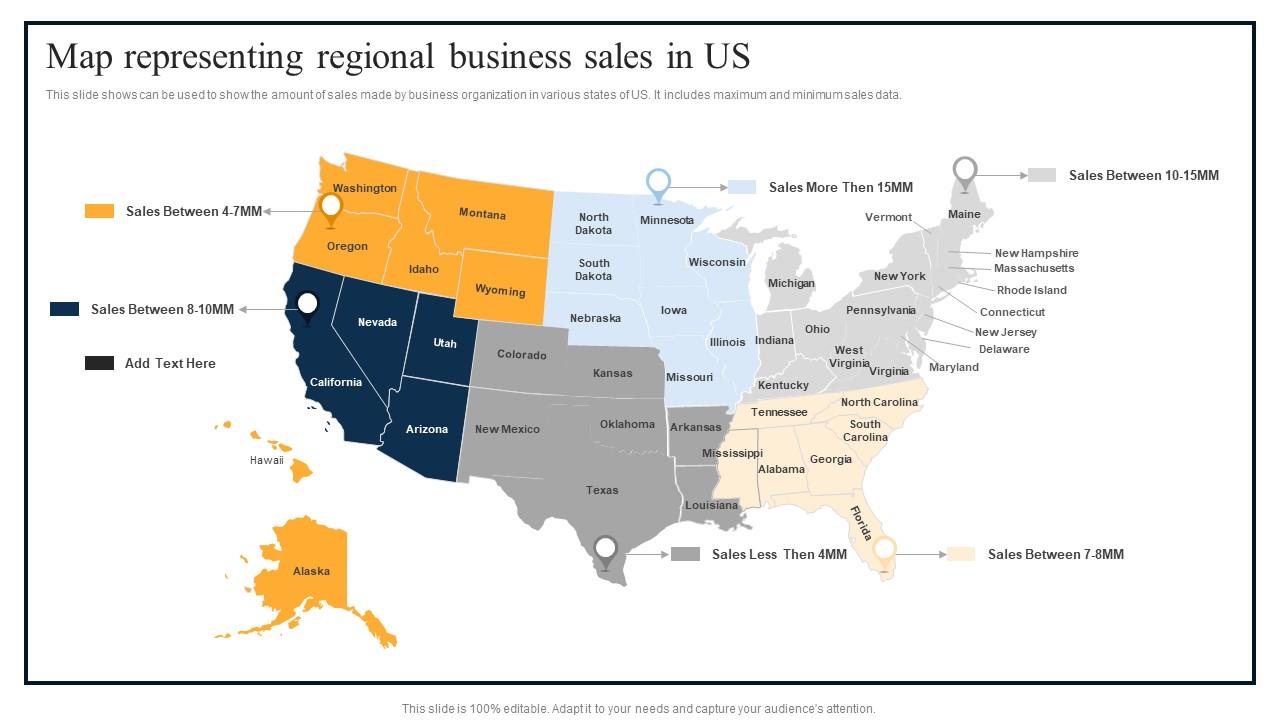
At first glance, national maps seem like the most logical way to visualize the United States. They convey scale, ambition, and reach. Yet in practice, most US businesses—especially those making operational, sales, and growth decisions—consistently prefer regional maps over national views.
This preference is not aesthetic. It reflects how businesses actually operate, compete, and grow inside the US. Regional maps align more closely with economic reality, organizational structure, and decision-making needs than broad national overviews ever can.
The US Is Too Large to Behave as One Market
The United States may be a single country, but it does not function as a single market.
Consumer behavior, labor dynamics, regulation, logistics costs, and competitive intensity vary widely across regions. A national map often smooths over these differences, creating a false sense of uniformity.
Regional maps reintroduce reality. They show that:
- Growth concentrates in specific corridors
- Demand clusters unevenly
- Costs vary sharply by region
- Competition is rarely national in practice
For businesses making real decisions, this nuance matters more than national symbolism.
Strategy Is Executed Regionally, Not Nationally
While strategy may be discussed at the national level, execution almost always happens regionally.
US businesses organize around:
- Sales regions
- Distribution zones
- Service territories
- Regional management teams
Regional maps mirror this structure. They allow leaders to:
- Assign accountability clearly
- Measure performance realistically
- Compare like-for-like markets
A national map may look impressive, but it rarely helps a regional VP understand what to fix or where to invest next.
Regional Maps Reduce Cognitive Load
National maps ask viewers to process too much information at once.
They often include:
- Dozens of states
- Vast geographic variation
- Multiple market conditions layered together
Regional maps narrow the frame. By limiting geography, they:
- Focus attention
- Improve pattern recognition
- Speed up comprehension
US business audiences are time-constrained. Regional maps allow them to grasp insight quickly without mentally filtering irrelevant areas.
Business Performance Clusters Regionally
Revenue, customer acquisition, churn, and cost structures rarely distribute evenly across the country.
Instead, performance clusters:
- Coastal metros behave differently than interior markets
- Sun Belt regions grow faster than legacy industrial zones
- Urban corridors outperform rural expanses
Regional maps make these clusters visible. National maps tend to dilute them, making strong and weak regions blur together.
For decision-makers, seeing clusters is far more actionable than seeing coverage.
Regional Context Explains “Why,” Not Just “Where”
A national view can show where something is happening. A regional view often explains why.
Within a region, it becomes easier to layer:
- Demographics
- Infrastructure
- Climate
- Regulation
- Competitive density
These contextual factors are easier to interpret when geography is constrained. US businesses rely on this context to diagnose problems and predict outcomes.
Sales and Go-To-Market Are Region-Driven
Sales teams in the US almost never operate nationally in practice.
They work by:
- Territory
- Region
- Metro cluster
Regional maps help sales leaders:
- Balance territories
- Identify white space
- Allocate resources fairly
A national map may show total coverage, but it does not help answer questions like:
- Which region is underperforming relative to peers?
- Where should headcount increase?
- Which markets justify premium pricing?
Regional views make these decisions tangible.
Regulation and Policy Vary by Region
While laws are written at the federal and state level, their impact often plays out regionally.
Examples include:
- Labor markets
- Housing constraints
- Environmental exposure
- Infrastructure investment
Regional maps allow businesses to visualize how policy and regulation affect clusters of states or metros with shared characteristics.
This is particularly important in industries like healthcare, energy, logistics, and finance, where regulatory environments shape cost and feasibility.
Regional Growth Patterns Are More Predictive Than National Trends
National averages hide momentum.
A flat national growth rate can mask:
- Rapid expansion in one region
- Stagnation or decline in another
Regional maps expose leading indicators. They show where demand is accelerating before it shows up in national metrics.
US businesses that prioritize regional mapping tend to:
- Enter growth markets earlier
- Exit declining markets faster
- Allocate capital more efficiently
Regional Maps Improve Internal Alignment
Large organizations struggle with alignment because teams operate in different geographies.
Regional maps act as a shared reference:
- Everyone sees the same territory definitions
- Performance comparisons feel fair
- Strategic priorities feel grounded
This shared understanding reduces internal friction. National maps often feel abstract, while regional maps feel personal and relevant.
National Maps Are Better for Storytelling, Not Decisions
National maps still have value—but their value is symbolic rather than operational.
They work well for:
- Investor storytelling
- Brand positioning
- Vision-setting
They work poorly for:
- Resource allocation
- Performance management
- Tactical planning
US businesses increasingly separate these use cases. National maps open the story. Regional maps drive the decisions.
Regional Maps Support Phased Thinking
Growth in the US rarely happens everywhere at once.
It happens in phases:
- One region proves the model
- Adjacent regions follow
- Expansion radiates outward
Regional maps naturally support this phased narrative. They allow businesses to show progression without overpromising national dominance too early.
This realism builds credibility—internally and externally.
Over-Specification Is Easier to Manage Regionally
Maps that try to show too much become unreadable.
Regional maps allow for:
- More detailed labeling
- Clearer segmentation
- Better layering of data
Instead of compressing complexity into a single national frame, businesses distribute complexity across multiple regional views.
This modularity improves clarity and reduces misinterpretation.
Regional Identity Still Shapes US Markets
Cultural and economic identity remains strong across US regions.
Differences in:
- Consumer preferences
- Brand resonance
- Communication style
- Price sensitivity
…are often regional rather than national.
Regional maps respect this reality. They help businesses adapt messaging and offerings without assuming one-size-fits-all behavior.
When National Views Become Actively Misleading
In some cases, national maps do more harm than good.
They can:
- Overstate coverage
- Hide operational gaps
- Encourage premature scaling
- Mask concentration risk
Regional maps surface these issues earlier, allowing businesses to correct course before problems compound.
Conclusion: Regional Maps Match How US Businesses Really Operate
US businesses prefer regional maps because they reflect how work actually gets done.
Strategy may be national, but execution is regional. Performance clusters regionally. Risk concentrates regionally. Growth emerges regionally.
Regional maps reduce cognitive load, improve clarity, support accountability, and align with real decision-making structures. They turn geography from a backdrop into a tool.
For mapsandlocations.com, this preference reinforces a core insight: effective maps are not about showing everything—they are about showing what matters most. In the US business landscape, what matters most is rarely the entire country at once.