
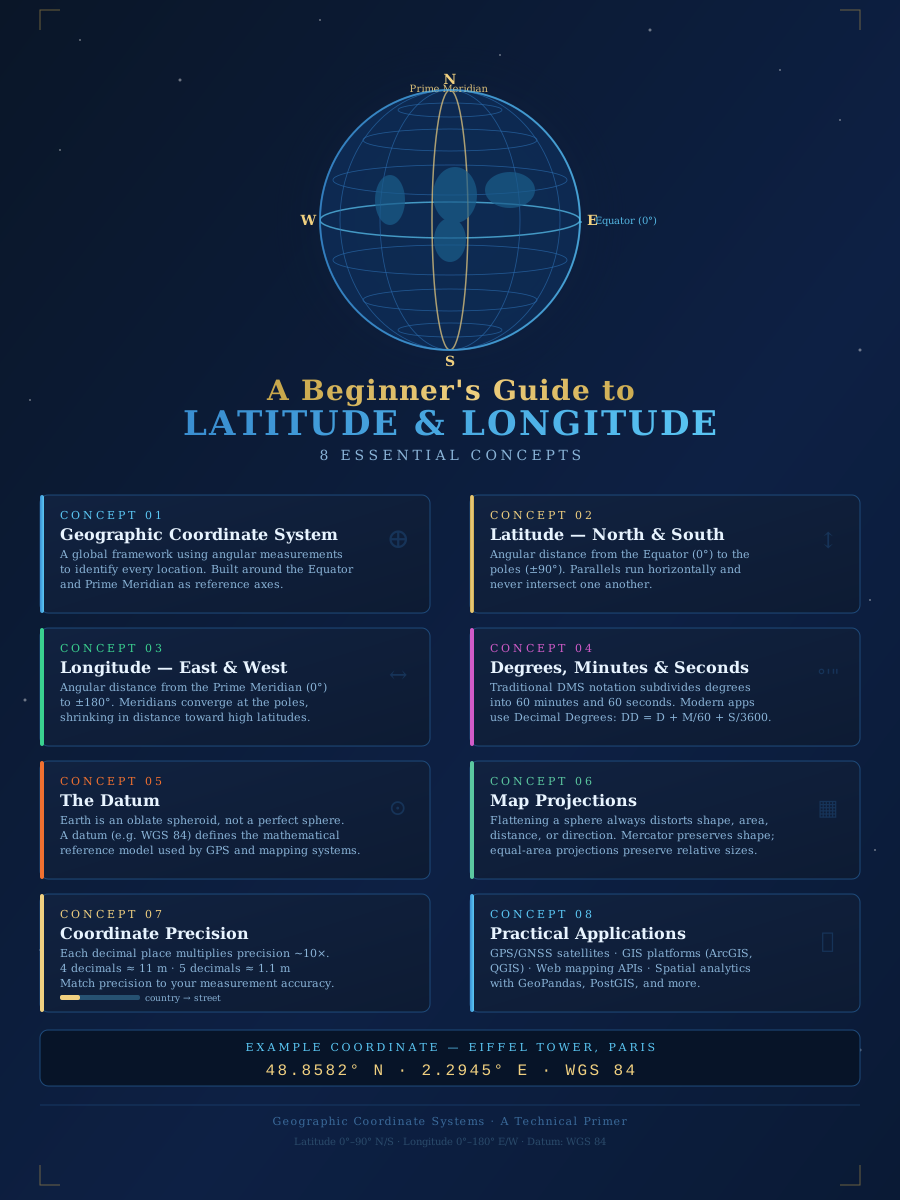
A Beginner’s Guide to Latitude and Longitude: 8 Essential Concepts
A Technical Introduction to Geographic Coordinate Systems
Introduction
Every point on Earth can be described precisely using just two numbers. Whether you are navigating with a smartphone, tracking a weather balloon, or mapping a hiking trail, the underlying system is the same: a global grid of latitude and longitude coordinates. This guide breaks down the eight most important concepts you need to understand this system, from its historical origins to its modern digital applications.
Even if you have never studied geography formally, by the end of this guide you will have a solid conceptual and practical foundation for working with geographic coordinate systems.
Concept 1: The Geographic Coordinate System (GCS)
A Geographic Coordinate System (GCS) is a framework for identifying every location on Earth’s surface using a pair of angular measurements. Rather than measuring distances in feet or meters, the GCS measures angles relative to a reference point at Earth’s center.
The system is built around two fundamental axes:
- The Equator — an imaginary horizontal circle dividing Earth into the Northern and Southern Hemispheres.
- The Prime Meridian — an imaginary vertical line running through Greenwich, England, dividing Earth into the Eastern and Western Hemispheres.
Together, these two reference lines form a grid that wraps around the entire globe. The GCS is the conceptual foundation on which all latitude and longitude measurements are based.
Concept 2: Latitude — Measuring North and South
Latitude measures how far north or south a point is from the Equator. It is expressed in degrees, ranging from 0° at the Equator to 90° at either pole.
Lines of latitude are called parallels because they run parallel to the Equator and never intersect one another. Key parallels include:
- 0° — The Equator, the baseline for all latitude measurements.
- 23.5° N / 23.5° S — The Tropic of Cancer and Tropic of Capricorn, marking the sun’s maximum overhead positions.
- 66.5° N / 66.5° S — The Arctic and Antarctic Circles, defining polar day and night zones.
- 90° N / 90° S — The North and South Poles.
Positive latitudes indicate the Northern Hemisphere; negative values indicate the Southern Hemisphere. For example, New York City sits at approximately 40.7° N, while Sydney, Australia is near 33.9° S.
Concept 3: Longitude — Measuring East and West
Longitude measures how far east or west a point is from the Prime Meridian. It ranges from 0° at the Prime Meridian to 180° in either direction, with 180° East and 180° West meeting at the International Date Line in the Pacific Ocean.
Lines of longitude are called meridians. Unlike parallels, meridians are not parallel to each other — they converge at the poles. This is a critical geometric distinction: the distance represented by one degree of longitude shrinks as you move away from the Equator toward the poles.
At the Equator, one degree of longitude equals approximately 111 kilometers. At 60° latitude, that same degree spans only about 55 kilometers. At the poles, all meridians converge to a single point, making longitude meaningless as a directional measure.
Positive longitudes indicate the Eastern Hemisphere; negative values indicate the Western Hemisphere. London sits near 0°, Tokyo near 139.7° E, and Los Angeles near 118.2° W (written as -118.2°).
Concept 4: Degrees, Minutes, and Seconds (DMS)
Coordinates are not always expressed as simple decimal numbers. The traditional format subdivides each degree into smaller angular units using a system borrowed from ancient astronomy:
- 1 Degree (°) = 60 Minutes (‘)
- 1 Minute (‘) = 60 Seconds (“)
This is called Degrees-Minutes-Seconds (DMS) notation. For example, the Eiffel Tower is located at:
48° 51′ 29.6″ N, 2° 17′ 40.2″ E
In modern digital systems, coordinates are more commonly expressed as Decimal Degrees (DD), which converts minutes and seconds into a single decimal number:
48.8582° N, 2.2945° E
To convert from DMS to DD, use the formula:
DD = Degrees + (Minutes / 60) + (Seconds / 3600)
Concept 5: The Datum — Earth Is Not a Perfect Sphere
One of the most commonly overlooked aspects of geographic coordinates is the datum. A datum is a mathematical model of Earth’s shape used as the reference surface for coordinate calculations.
Earth is not a perfect sphere. It bulges slightly at the Equator and is flattened at the poles — a shape called an oblate spheroid. Additionally, Earth’s surface has an irregular gravitational field, which further complicates precise measurement. Different datums account for these irregularities differently.
The most widely used datum today is WGS 84 (World Geodetic System 1984), which underpins the GPS satellite network. However, older maps and regional surveying systems often use different datums — such as NAD27 (North American Datum of 1927) or ED50 (European Datum 1950). Mixing datums without accounting for the difference can introduce positional errors of up to hundreds of meters.
Whenever you work with geographic coordinates from different sources, always verify which datum is in use. This is a foundational step in GIS (Geographic Information Systems) workflows.
Concept 6: Map Projections and Coordinate Distortion
A core challenge in cartography is representing a three-dimensional sphere on a flat, two-dimensional surface. This transformation — called a map projection — always introduces some form of distortion. No flat map of the entire Earth can accurately preserve all of the following simultaneously:
- Shape (conformal maps preserve local angles)
- Area (equal-area projections preserve relative sizes)
- Distance (equidistant projections preserve distances from specific points)
- Direction (azimuthal projections preserve compass bearings from a central point)
The most familiar projection, the Mercator projection, preserves shape and direction — making it ideal for navigation — but severely distorts area at high latitudes. This is why Greenland appears comparable in size to Africa on many world maps, even though Africa is approximately 14 times larger.
For web mapping applications, the Web Mercator projection (EPSG:3857) has become the de facto standard, used by Google Maps, OpenStreetMap, and most other digital mapping services.
Concept 7: Coordinate Precision and Spatial Accuracy
The number of decimal places in a coordinate directly determines its spatial precision. Understanding this relationship is essential for any application that relies on accurate positioning.
| Decimal Places | Approximate Precision | Practical Use |
| 0 | ~111 km | Country level |
| 1 | ~11 km | Large city |
| 2 | ~1.1 km | Town or district |
| 3 | ~111 m | Neighborhood |
| 4 | ~11 m | Parcel of land |
| 5 | ~1.1 m | Individual tree or structure |
| 6 | ~0.11 m (11 cm) | Engineering surveys |
| 7 | ~1.1 cm | High-precision GPS |
For most consumer applications, 4–5 decimal places provide more than adequate precision. Storing coordinates with excessive decimal places wastes storage space and implies a level of accuracy that measurement instruments may not actually achieve.
Concept 8: Practical Applications and Modern Uses
Latitude and longitude coordinates are the backbone of an enormous range of modern technologies. Understanding them opens the door to working with geospatial data across many domains.
Global Navigation Satellite Systems (GNSS)
The GPS system operated by the United States — along with Russia’s GLONASS, Europe’s Galileo, and China’s BeiDou — all use the WGS 84 coordinate system. Receivers calculate position by measuring the time it takes for signals to arrive from multiple satellites. Modern smartphones can achieve positional accuracy of 1–5 meters under ideal conditions.
Geographic Information Systems (GIS)
GIS platforms such as ArcGIS, QGIS, and Google Earth Engine use latitude/longitude as the common language for integrating spatial datasets. Analysts overlay layers — satellite imagery, census data, infrastructure maps, climate readings — all anchored by geographic coordinates.
Web APIs and Location Services
The Google Maps API, Mapbox, and OpenStreetMap all accept and return coordinates in decimal degrees. Developers working with these services pass latitude and longitude values to render maps, calculate routes, find nearby points of interest, and build location-aware applications.
Data Science and Spatial Analytics
In data science, geospatial libraries such as GeoPandas (Python), sf (R), and PostGIS (PostgreSQL) use coordinate systems to perform spatial queries — for example, finding all hospitals within 10 kilometers of a flood zone, or clustering delivery points to minimize route distances. These operations depend entirely on a shared, accurate coordinate reference system.
Conclusion
Latitude and longitude form the universal language of location. The eight concepts covered in this guide — the Geographic Coordinate System, latitude, longitude, degree notation formats, geodetic datums, map projections, coordinate precision, and real-world applications — give you a robust conceptual toolkit for working with geographic data.
As you begin applying these concepts, keep three principles in mind:
- Always confirm the datum and projection being used before combining data from different sources.
- Use decimal degrees for computational work and DMS notation for human-readable displays.
- Match your coordinate precision to the actual accuracy of your measurement source.
With these fundamentals in place, you are well-equipped to explore deeper topics such as geodesy, spatial indexing, coordinate transformations, and the rich ecosystem of open-source geospatial tools that have made location intelligence accessible to developers and analysts everywhere.