
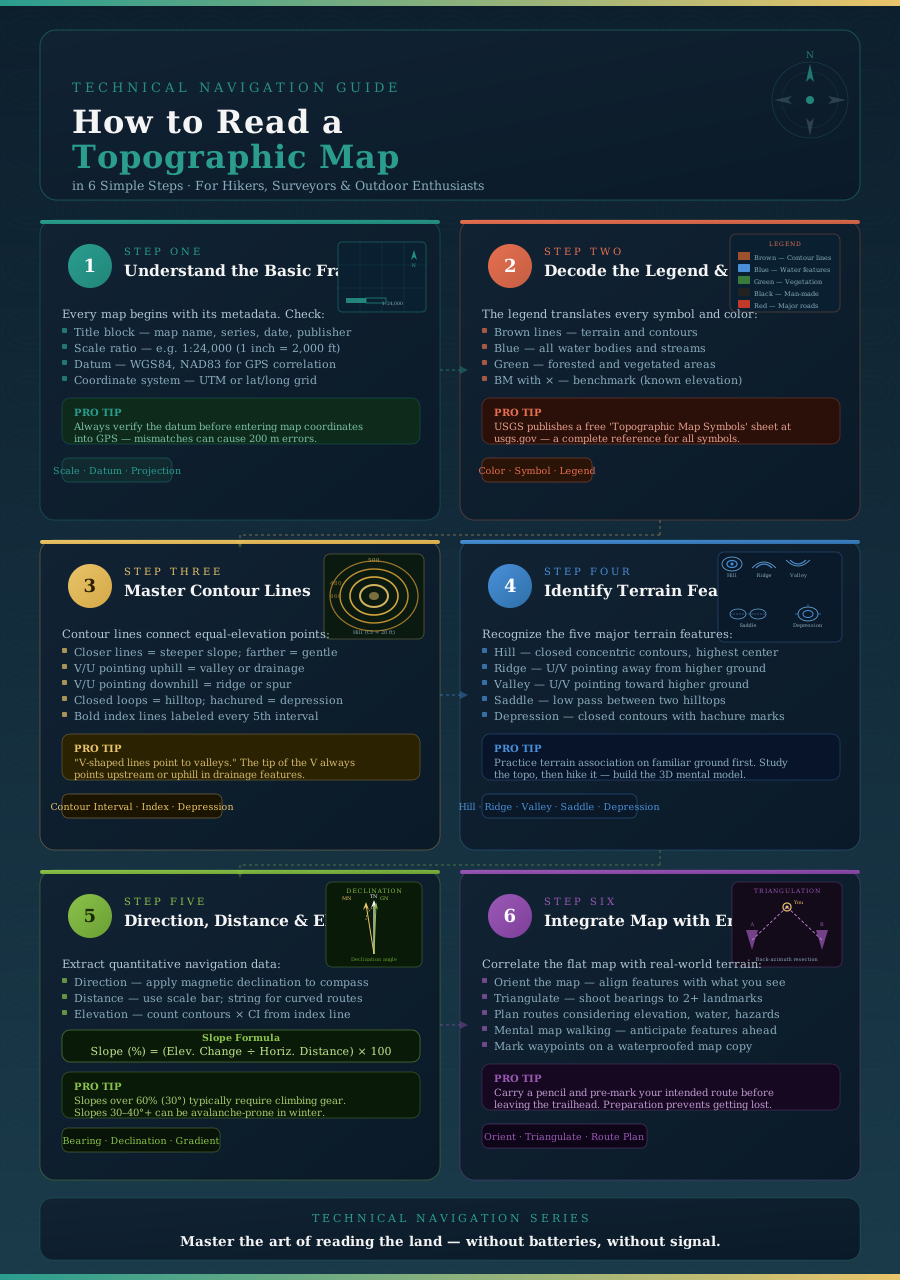
How to Read a Topographic Map in 6 Simple Steps
Introduction
Topographic maps are among the most powerful tools in navigation and land analysis. Unlike standard road maps that only show a two-dimensional view of the world, topographic maps — also called ‘topo maps’ or ‘contour maps’ — represent three-dimensional terrain on a flat surface, giving you critical information about elevation, slope, and landscape features.
Whether you are a backcountry hiker planning a multi-day expedition, a civil engineer assessing a construction site, or a search-and-rescue volunteer, the ability to read a topographic map accurately can be the difference between success and failure — and in some cases, between life and death.
This guide breaks down the process into six manageable steps, systematically building your understanding from the map’s basic framework to advanced terrain interpretation.
Step 1: Understand the Map’s Basic Framework
Before you can interpret any map, you need to understand its metadata — the key information that defines the map’s scale, datum, and orientation.
The Title Block
Every topographic map includes a title block, usually located in the margin. It contains the map name (often a local geographic feature), the quadrangle series (e.g., 7.5-minute series), the date of publication, and the publishing authority (such as the USGS in the United States).
Map Scale
Scale is the ratio between a distance on the map and the corresponding distance on the ground. Common topographic map scales include:
- 1:24,000 — The standard USGS 7.5-minute quadrangle (1 inch = 2,000 feet)
- 1:50,000 — Common in many international mapping systems
- 1:100,000 — Useful for regional planning and overview navigation
A larger scale (smaller ratio number) means more detail and less area coverage, while a smaller scale means less detail but broader coverage. Always check the graphic scale bar at the map’s bottom margin, which remains accurate regardless of photocopy enlargement or reduction.
Map Datum and Coordinate Systems
Modern topographic maps reference a geodetic datum — a mathematical model of the Earth used to define coordinate positions. Common datums include WGS84 (used by GPS) and NAD27 or NAD83 (common in North American maps). Understanding which datum your map uses is essential if you are correlating it with GPS coordinates.
Pro Tip: Always verify the datum before entering map coordinates into a GPS device. A datum mismatch can introduce errors of up to 200 meters in some regions.
Step 2: Decode the Legend and Symbology
The map legend (or key) is your Rosetta Stone. It explains every symbol, color, and line style used on the map. Topographic maps use a standardized color and symbol system:
Color Coding
- Brown — Contour lines and land features
- Blue — Water features (rivers, lakes, swamps, glaciers)
- Green — Vegetation (forests, orchards, vineyards)
- Black — Human-made features (roads, buildings, boundaries, railways)
- Red — Major roads and land grant lines
- White — Open areas with little or no vegetation
- Purple — Features added from aerial photography updates (photoinspected)
Common Map Symbols
Beyond colors, topographic maps use hundreds of standardized symbols to represent features such as:
- Benchmarks (BM) with an X mark — surveyed elevation points of known precision
- Triangulation stations — used in geodetic surveys
- Intermittent vs. perennial streams — distinguished by line style
- Buildings, campgrounds, picnic areas, and ranger stations
Pro Tip: The USGS publishes a comprehensive ‘Topographic Map Symbols’ reference sheet (available free at usgs.gov) that lists every symbol used in their 7.5-minute quadrangles.
Step 3: Master Contour Lines
Contour lines are the defining feature of a topographic map and represent the most important concept to master. A contour line connects all points on the map that share the same elevation above sea level (or another datum).
The Contour Interval
The contour interval (CI) is the constant vertical distance between adjacent contour lines. For example, if the CI is 40 feet, each contour line is 40 feet higher (or lower) than the one next to it. The CI is printed in the map margin below the scale bar. Never assume a CI — always verify it from the legend.
Index Contours vs. Intermediate Contours
Index contours are darker, heavier lines printed every 5th contour interval, with the elevation labeled along the line. Intermediate contours are the lighter, unlabeled lines in between. Some maps also include supplementary contours — dashed or dotted lines used to show terrain detail in areas where the standard CI would leave large gaps.
Key Rules for Reading Contour Lines
- Contour lines never cross — if they appear to merge, one is a cliff, and the lines may touch but will not actually intersect
- The closer together the contour lines, the steeper the terrain
- The farther apart the contour lines, the gentler the slope
- Contour lines that form a ‘V’ or ‘U’ shape pointing uphill indicate a valley, stream, or drainage
- Contour lines that form a ‘V’ or ‘U’ shape pointing downhill indicate a ridge or spur
- Closed contour lines indicate a hilltop (ascending inward) or a depression (with hachure marks on the downhill side)
Pro Tip: A useful mnemonic: ‘V-shaped lines point to valleys.’ The point of the V always points upstream or uphill in drainage features.
Step 4: Identify Terrain Features
Once you understand contour lines, you can begin to read the landscape as if you were standing on it. Experienced map readers develop the ability to visualize three-dimensional terrain from a flat map with practice.
The Five Major Terrain Features
- Hill — A rounded area of high ground. Shown by concentric closed contour lines, with the highest elevation at the center.
- Ridge — A line of high ground with sloping sides. Contour lines form U- or V-shapes pointing away from higher ground.
- Valley — An elongated, low-lying area between ridges. Contour lines form U- or V-shapes pointing toward higher ground.
- Saddle — A low point between two hilltops on a ridge. Appears as an hourglass or figure-eight pattern of contour lines.
- Depression — A low area surrounded by higher ground. Shown by closed contour lines with hachure (tick) marks pointing inward.
Minor Terrain Features
Beyond the five major features, topographic maps also reveal cliffs (contour lines that converge or overlap), draws (small stream drainage channels), and spurs (short ridges that extend laterally from a main ridge). Learning to identify these features quickly is essential for accurate route planning.
Pro Tip: Practice terrain association by studying a topo map of an area you know well, then field-checking your interpretations in person. This builds the mental bridge between the flat map and three-dimensional reality.
Step 5: Determine Direction, Distance, and Elevation
Reading terrain features is only part of the skill. For practical navigation, you also need to extract quantitative information from the map.
Determining Direction
Topographic maps are oriented with true north at the top (usually). However, the map’s margin includes a declination diagram showing the relationship between three norths: True North (geographic north pole), Magnetic North (where a compass needle points), and Grid North (the direction of the map’s vertical grid lines).
Magnetic declination varies by location and changes slightly over time. In western North America, declination is typically eastward (positive); in the eastern U.S., it is typically westward (negative). Always apply the appropriate declination correction when using a compass with a topo map.
Measuring Distance
Use the graphic scale bar in the map margin to measure horizontal (map) distance. For curved routes like trails, use a piece of string or a map measurer (opisometer). Remember that map distance measures horizontal distance only — actual ground distance on slopes is always greater.
Calculating Elevation and Slope
To find the elevation of any point, count contour lines from the nearest labeled index contour and multiply by the CI. To calculate average slope gradient between two points, use the formula:
Slope (%) = (Elevation Change ÷ Horizontal Distance) × 100
For example, a 400-foot elevation gain over 2,000 feet of horizontal distance yields a 20% slope — a steep but hikeable gradient.
Pro Tip: A slope greater than 60% (about 30 degrees) is generally considered difficult to traverse on foot without climbing equipment, and slopes above 30–40 degrees may be avalanche-prone in winter conditions.
Step 6: Integrate the Map with Your Environment
The final and most sophisticated step is terrain association — correlating what you see on the map with what you observe in the field. This skill transforms you from someone who can read a map into a true navigator.
Orienting the Map
Begin by orienting your map to the terrain. Turn the map until its features align with the features you see in front of you. If you have a compass, align the map’s north with magnetic north (accounting for declination). An oriented map is vastly easier to read and reduces directional errors.
Finding Your Position
To determine your location, use a technique called triangulation (or resection). Identify two or more prominent landmarks visible in the field and also visible on the map. Shoot a bearing to each landmark with your compass, apply the back-azimuth (add or subtract 180°), and draw lines from each landmark on the map. Your position is near the intersection of these lines.
Planning Routes
Use the map to plan routes that consider:
- Elevation gain and loss — minimizing unnecessary vertical effort
- Water sources — blue features indicating streams or lakes
- Vegetation — green areas that may indicate dense cover and slower travel
- Hazards — cliffs, avalanche chutes, or swampy terrain (hachured contours, blue stippled areas)
Anticipating What You Will See
Before you move, study the map and mentally rehearse what terrain features should appear and in what order. This predictive approach — sometimes called ‘mental map walking’ — dramatically improves your confidence and accuracy in the field.
Conclusion
Reading a topographic map is a skill built on layers of knowledge, each step reinforcing the next. By mastering the map’s basic framework, decoding its symbology, understanding contour lines, identifying terrain features, extracting quantitative data, and finally integrating the map with the real world, you gain a profound ability to understand and navigate the landscape.
Unlike GPS devices, a paper topographic map requires no battery, no signal, and no internet connection. It is waterproof when laminated, lightweight, and effectively infinite in resolution when read by a skilled navigator. In any serious outdoor or field activity, it remains the gold standard of navigation tools.
Practice regularly, go to familiar terrain to test your skills, and gradually challenge yourself with new and more complex landscapes. With time, the abstract lines and symbols of a topographic map will become as vivid and readable as a photograph of the land itself.

