
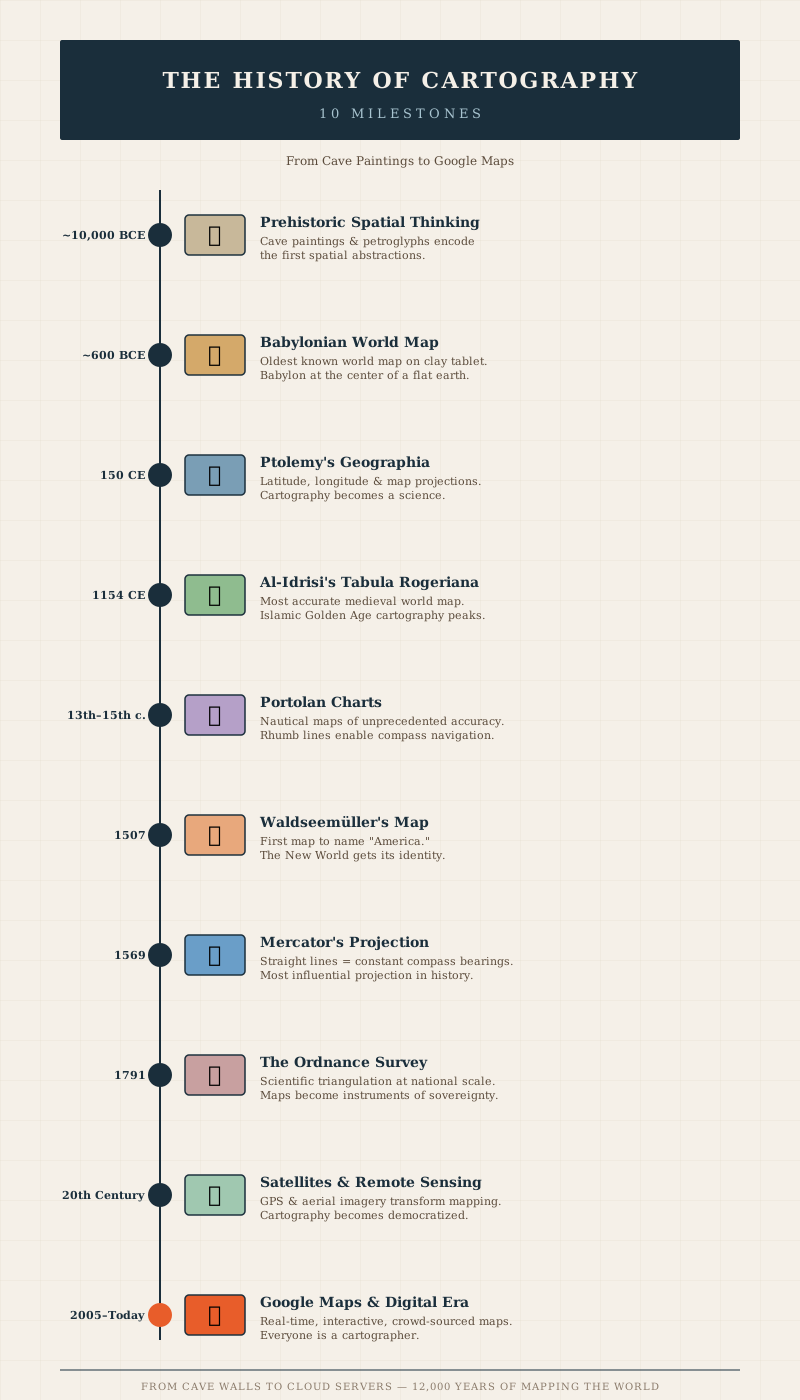
The History of Cartography: 10 Milestones From Cave Paintings to Google Maps
How humanity’s obsession with knowing “where we are” shaped science, empire, exploration, and the modern digital world.
Cartography, the science and art of making maps, is one of the oldest and most consequential human endeavors. Long before writing, before mathematics, before philosophy, people drew pictures of their world. They scratched rivers into rock, painted hunting grounds on cave walls, and etched coastlines into clay. Every civilization that rose to power did so, in part, because it could represent space accurately enough to navigate it, tax it, conquer it, and trade across it.
The history of cartography is not a smooth progression from crude drawings to satellite imagery. It is a story full of wrong turns, ideological detours, technical breakthroughs, and paradigm shifts, a story that mirrors humanity’s evolving understanding of science, politics, and the nature of knowledge itself. Here are ten milestones that mark the most pivotal moments in that story.
Milestone 1: The Bedolina Petroglyph and Prehistoric Spatial Thinking (~10,000–2,000 BCE)
Before there were maps, there were spatial memories carved in stone. The Bedolina Map, etched into a rock face in the Val Camonica valley of northern Italy and dated to approximately 2,000–1,500 BCE (though some features may be older), is one of the earliest surviving examples of a topographic representation. It depicts a landscape of interconnected paths, huts, fields, and what appear to be water channels, a kind of proto-cadastral map of a community’s territory.
Even earlier, cave paintings at Lascaux (c. 17,000 BCE) and other Upper Paleolithic sites, while not maps in a strict sense, reveal a sophisticated capacity for spatial abstraction. Some researchers argue that certain groupings of dots and lines in these paintings represent star constellations or landscape features, suggesting that symbolic spatial reasoning predates agriculture itself.
The cognitive leap captured by these artifacts is profound: the ability to represent three-dimensional space on a two-dimensional surface, and to compress the experience of moving through a landscape into a static image that can be shared, studied, and planned against. This abstraction is the foundational act of cartography.
Technical significance: The emergence of spatial representation indicates the development of allocentric thinking, the ability to model space from a perspective outside one’s own body, a cognitive capacity that distinguishes advanced navigation from simple path-following.
Milestone 2: The Babylonian World Map (~600 BCE)
Housed today in the British Museum, the Babylonian Mappa Mundi is the oldest known map of the world. Inscribed on a clay tablet in cuneiform script, it depicts Babylon at the center of a flat, circular world surrounded by a great ocean (the “bitter river”), with several named regions radiating outward. Beyond the ocean, triangular shapes mark mythological territories accessible only after crossing the waters.
What makes this artifact technically significant is not its geographic accuracy, it is highly schematic, but its conceptual ambition. The Babylonians were attempting to represent not just local territory but the totality of the known world in a single, unified image. The map is explicitly cosmological: it places Babylon at the center not merely as an empirical observation but as a theological statement about the city’s cosmic importance.
This tension between empirical observation and ideological projection is one that would recur throughout cartographic history. Maps have never been purely neutral, they embed the worldview, priorities, and power structures of their makers. The Babylonian World Map makes this explicit in a way that later, more technically sophisticated maps often obscure.
Technical significance: First known attempt at a world map. Introduces the concept of map as cosmological and political document, not merely a navigational tool.
Milestone 3: Ptolemy’s Geographia (~150 CE)
Claudius Ptolemy, the Greco-Egyptian astronomer and mathematician working in Alexandria, produced a work in the second century CE that would define cartographic practice for over a thousand years. His Geographia (or Geography) did several things no previous text had done systematically: it established a coordinate system using latitude and longitude, it described methods for projecting the spherical Earth onto a flat surface, and it provided a catalogue of over 8,000 place names with their estimated coordinates.
Ptolemy’s projection methods were technically sophisticated. He described two conic projections and acknowledged the mathematical problem at the heart of cartography, that you cannot represent a sphere on a plane without distortion. He proposed different projections as trade-offs depending on the region being mapped.
His estimates of longitude were systematically off (he underestimated the circumference of the Earth and overestimated the extent of the Eurasian landmass), errors that would have enormous historical consequences. Christopher Columbus, working from corrupted versions of Ptolemy’s data, believed the distance westward from Europe to Asia was far shorter than it actually was, a misconception that led him to attempt, and accidentally complete, the crossing of the Atlantic.
Geographia was lost to Western Europe during the early medieval period but preserved in Byzantium and the Islamic world. Its rediscovery and translation into Latin in 1406 CE ignited a revolution in Renaissance cartography.
Technical significance: First systematic use of latitude/longitude coordinates. Introduction of mathematical map projections. Establishment of cartography as a quantitative, scientific discipline.
Milestone 4: Islamic Golden Age Cartography, Al-Idrisi’s Tabula Rogeriana (1154 CE)
While medieval European cartography was dominated by the Mappa Mundi tradition, schematic, theologically oriented maps that placed Jerusalem at the center, Islamic cartographers were advancing the science of geography with empirical rigor informed by Ptolemy, direct observation, and the vast geographic intelligence of a trading civilization that stretched from Spain to Southeast Asia.
Muhammad al-Idrisi, working at the court of King Roger II of Sicily, one of the most cosmopolitan courts in the medieval Mediterranean, spent fifteen years compiling geographic observations from traders, travelers, and earlier scholars. His masterpiece, the Tabula Rogeriana (also known as Kitab Rujar or “The Book of Roger”), completed in 1154, was the most accurate and comprehensive world map produced up to that point in history.
The Tabula Rogeriana covers Eurasia and North Africa in remarkable detail, with coastlines, river systems, and mountain ranges represented with a fidelity that would not be surpassed for several centuries. It is oriented with south at the top, a convention common in Islamic cartography, which can be disorienting for modern viewers accustomed to north-up maps, but which has no technical superiority or inferiority; it is a convention, not an empirical necessity.
Al-Idrisi also compiled an accompanying text of 70 regional maps and geographic commentary running to several volumes, an encyclopedic geographic survey that served as the definitive reference for Arabic and European scholars for centuries.
Technical significance: Integration of empirical observation, mathematical geography, and cross-cultural intelligence gathering. Most accurate world map of its era. Demonstrated that cartographic progress in this period was occurring primarily in the Islamic world, not in Christian Europe.
Milestone 5: The Portolan Chart Revolution (13th–15th Centuries)
Around the late 13th century, a new type of map appeared in the Mediterranean, one so practically accurate that its origins remain somewhat mysterious. The portolan chart (from the Italian portolano, meaning a collection of sailing directions) was a nautical map of unprecedented precision, depicting coastlines, harbors, hazards, and landmarks with a fidelity to actual geometry that earlier maps entirely lacked.
The earliest surviving portolan chart, the Carta Pisana (c. 1290), covers the Mediterranean and Black Sea with a level of coastal accuracy that approaches what we would expect from 18th-century surveys. This accuracy was achieved not through mathematical projection or astronomical observation, but through the systematic accumulation of compass bearings and estimated distances by generations of Mediterranean sailors.
Portolan charts are covered with a characteristic network of rhumb lines, lines radiating from compass roses, which allowed navigators to identify the bearing between any two points on the chart. They did not use standard latitude/longitude grids, and they were not mathematically projected in Ptolemy’s sense; they were effectively empirical constructions built up from many overlapping local observations.
The portolan chart tradition demonstrates an important principle: practical navigational needs can drive cartographic accuracy independent of theoretical frameworks. Sailors needed to know where the rocks were, and they built tools that told them.
Technical significance: First maps to achieve systematic, practical accuracy for navigational use. Introduction of rhumb lines and compass-rose networks. Development of an empirical, survey-based cartographic tradition distinct from the theoretical/astronomical tradition.
Milestone 6: Waldseemüller’s Map and the Naming of America (1507)
On April 25, 1507, Martin Waldseemüller, a German cartographer working in the small town of Saint-Dié-des-Vosges in Lorraine, published a world map on twelve sheets of paper, assembled, they measure roughly 2.4 by 1.3 meters, that changed the world in a very specific way: it was the first document to use the name “America.”
Waldseemüller based his depiction of the western continents on the accounts of the Florentine explorer Amerigo Vespucci, who had argued, correctly, that the lands encountered by Columbus were not Asia but a previously unknown continent. The map names this new landmass “America” after Vespucci, printing the name in large letters across what is now Brazil.
The map is technically remarkable for its era. It depicts the Pacific Ocean as a separate body of water separating the Americas from Asia, an insight derived from indigenous and early explorer reports, six years before Balboa’s European “discovery” of the Pacific in 1513. It also shows South America with a reasonable approximation of its correct shape and roughly correct longitude, a feat of synthesis from fragmentary and often contradictory voyage reports.
Only one copy of Waldseemüller’s 1507 map survives. The Library of Congress acquired it in 2003 for $10 million — the highest price ever paid for a single document at that time. It has been called America’s birth certificate.
Technical significance: First cartographic synthesis of the post-Columbian world. First use of “America.” First cartographic representation of the Pacific as a discrete ocean. Demonstrates the map as a vehicle for establishing geopolitical reality through naming.
Milestone 7: Mercator’s Projection (1569)
In 1569, the Flemish cartographer Gerardus Mercator published a world map with a deceptively simple title: Nova et Aucta Orbis Terrae Descriptio ad Usum Navigantium Emendate Accommodata — “A New and Augmented Description of Earth Corrected for Use in Navigation.” The map introduced a projection that would become the most widely used in history: the Mercator projection.
Mercator’s key insight was that navigators need maps on which straight lines represent constant compass bearings — so-called rhumb lines. On a globe, a rhumb line spirals toward the poles; on a flat map, it needs to appear straight. Mercator achieved this by mathematically expanding the spacing between lines of latitude as they approach the poles, so that the north-south and east-west scales remain locally proportional at every point. The result is a map on which any straight line represents a true compass bearing — invaluable for navigation.
The mathematical underpinning of Mercator’s projection was not fully worked out by Mercator himself; the calculus needed to derive it rigorously was formulated by Edward Wright in 1599, two years after Mercator’s death. The projection is mathematically equivalent to “unrolling” a cylinder tangent to the Earth at the equator.
The Mercator projection’s famous distortion — Greenland appears roughly the size of Africa, though Africa is in reality about 14 times larger — is the inevitable cost of its navigational virtue. It preserves shape (it is conformal) but distorts area. This distortion has made it politically controversial, particularly in post-colonial discourse, because it visually inflates the size of high-latitude nations (Europe, North America, Russia) relative to equatorial ones (most of Africa, South and Southeast Asia). The Peters projection, introduced in 1973, was a deliberate political intervention presenting an equal-area alternative — though it introduced its own shape distortions.
Technical significance: First mathematically consistent conformal projection. Enabled reliable compass-bearing navigation. Introduced the concept of projection trade-offs (area vs. shape vs. direction) that remains central to modern cartography.
Milestone 8: The Ordnance Survey and the Age of Scientific National Mapping (1791–19th Century)
The late 18th and 19th centuries saw the rise of state-sponsored, scientifically rigorous national mapping programs — an infrastructure project of the first order that was simultaneously a military, administrative, and scientific enterprise.
The British Ordnance Survey, established in 1791, is paradigmatic. Its founding was driven explicitly by military necessity: the Jacobite risings of 1745 had revealed that the British Army had no reliable maps of the Scottish Highlands. General William Roy’s post-rebellion military survey of Scotland was the direct precursor to the Ordnance Survey. When the French Revolutionary Wars threatened invasion, the Survey was formalized to map the south coast of England.
The technical foundation of modern national mapping is triangulation — a method by which surveyors establish a network of triangles across a landscape, measuring angles from known baselines to calculate the positions of distant points with high precision. The Great Trigonometrical Survey of India (begun 1802) — which ultimately produced the measurement of Mount Everest’s height — was one of the most ambitious triangulation projects ever attempted, conducted over decades through jungle, desert, and Himalayan foothills, under constant threat of disease and political conflict.
These national surveys established something conceptually new: the idea of a complete, consistent, official representation of national territory — a map as an instrument of sovereignty. To be on the map was to be administered. To be accurately mapped was to be controlled.
Technical significance: Development of systematic triangulation networks. Establishment of geodetic frameworks (mathematical models of Earth’s shape) as the basis for national mapping. Integration of cartography with the modern nation-state apparatus.
Milestone 9: Aerial Photography, Remote Sensing, and the Topographic Revolution (20th Century)
The invention of powered flight in 1903 transformed cartography within a generation. Aerial photography, first used systematically in World War I for reconnaissance, made it possible to survey large areas of terrain rapidly and objectively, free from the laborious and error-prone ground-based triangulation methods that had dominated the previous century.
Photogrammetry — the science of extracting geometric measurements from photographs — developed rapidly through the interwar period. By World War II, aerial photographic surveys were producing accurate topographic maps of entire theaters of operation faster than any previous method. After the war, aerial survey became the standard method for producing and updating topographic maps worldwide.
The next revolution came from orbit. Beginning with the CORONA reconnaissance satellites of the early 1960s (declassified in 1995), and accelerating with the Landsat program launched in 1972, Earth observation from space provided continuous, synoptic coverage of the entire planet’s surface. Remote sensing — the use of satellite instruments to measure electromagnetic radiation reflected or emitted by the Earth’s surface — opened up new cartographic dimensions: land cover mapping, vegetation analysis, ocean temperature monitoring, ice sheet dynamics, urban growth tracking.
The Global Positioning System (GPS), developed by the U.S. Department of Defense and made available for civilian use in the 1980s–1990s, completed the revolution by making precise location determination available to any individual with a receiver. GPS replaced terrestrial survey networks as the primary means of establishing geographic position, democratizing access to high-precision location data in a way that would have been unimaginable to earlier cartographers.
Technical significance: Aerial photography and photogrammetry replaced ground survey for topographic mapping. Satellite remote sensing enabled global, repeat-coverage Earth observation. GPS democratized precise positioning. Together, these technologies shifted cartography from an elite, state-controlled enterprise to a broadly accessible one.
Milestone 10: Google Maps and the Era of Participatory, Dynamic, Ubiquitous Cartography (2005–Present)
On February 8, 2005, Google launched Google Maps. Within a few years, it had become the most widely used mapping platform in history — and had fundamentally changed what maps are, what they do, and who makes them.
Before Google Maps, digital mapping existed but was specialized, expensive, and largely inaccessible to the public. MapQuest offered routing. GIS software like ArcGIS was used by professionals. But maps remained, essentially, static objects: finished products published by national surveys or commercial cartographers.
Google Maps introduced several paradigm-shifting innovations simultaneously. The tile-based, dynamically loaded web map made it possible to seamlessly zoom from the continental scale to the street level. Google Street View (launched 2007) added ground-level photographic coverage of streets in hundreds of countries. The Maps API, released in 2005, allowed third-party developers to embed and customize maps in their own applications, unleashing an ecosystem of location-based services.
Perhaps most consequentially, Google Maps (and competitor platforms like OpenStreetMap, founded 2004) inaugurated the era of participatory cartography. OpenStreetMap, a collaborative project often called “the Wikipedia of maps,” relies on volunteer contributors worldwide to map roads, buildings, trails, and points of interest. It has produced detailed maps of regions — refugee camps, rural areas of the developing world, post-disaster zones — that commercial mapping organizations would never cover. After the 2010 Haiti earthquake, OpenStreetMap contributors mapped Port-au-Prince in greater detail than any official map had previously achieved, within days of the disaster.
The modern mapping stack — GPS devices, cloud computing, machine learning applied to satellite imagery, LiDAR-equipped street survey vehicles, real-time traffic data from millions of smartphone users — represents a cartographic system of staggering complexity and capability. Apple Maps processes billions of location requests per day. Google Maps has mapped over 220 countries and territories, with data contributed by a combination of satellite imagery, Street View cars, licensed data, and user contributions.
This cartographic abundance comes with new tensions. Location data is enormously valuable commercially, and the companies that hold it wield new kinds of power over privacy, commerce, and public behavior. Algorithmic map decisions — which businesses are shown, which routes are prioritized, which neighborhoods are mapped in detail — embed new forms of bias that are less visible but no less consequential than the ideological distortions of medieval mappae mundi.
Technical significance: Real-time, interactive, cloud-served mapping at global scale. Participatory cartography via crowdsourcing. Integration of GPS, remote sensing, machine learning, and big data. Transformation of the map from a finished document into a continuously updated, personalized service.
Conclusion: The Unchanging Imperative
Ten thousand years of cartographic history — from scratched petroglyphs to terabytes of satellite data — reflects a single, unchanging human imperative: to know where we are, and to share that knowledge with others. Every milestone in this history represents a new answer to the question of how to represent space accurately enough to be useful, whether the purpose is hunting, trading, conquest, administration, navigation, or simply satisfying the human desire to understand the world we inhabit.
What has changed, dramatically, is the scale, precision, accessibility, and speed of cartographic production — and with it, the political economy of who controls geographic knowledge. Maps have always been instruments of power. The shift from state-monopolized national surveys to commercial platforms and open collaborative databases represents a genuine democratization of cartographic production, even as it introduces new concentrations of power around the platforms that aggregate and serve that data.
The next chapter of cartographic history is already being written in real time — in the 3D city models being built from LiDAR point clouds, in the indoor mapping of building interiors, in augmented reality systems that overlay digital information on physical space, and in the autonomous vehicles whose navigation depends on maps of a precision and richness that would astonish even Mercator. The cave painter and the machine learning engineer are engaged, ultimately, in the same project: making the world legible.
This article covers key milestones in cartographic history for educational and technical audiences. Dates for prehistoric artifacts are approximate and subject to ongoing scholarly revision.