What Is a Geographic Information System (GIS)? 6 Things You Should Know
A Comprehensive Technical Guide
Geographic Information Systems (GIS) have quietly become one of the most transformative technologies of the modern era. From tracking disease outbreaks to optimizing delivery routes, from planning cities to monitoring deforestation, GIS underpins decisions that affect billions of people every day. Yet despite its pervasiveness, many professionals outside the geospatial field have only a vague understanding of what GIS actually is and how it works.
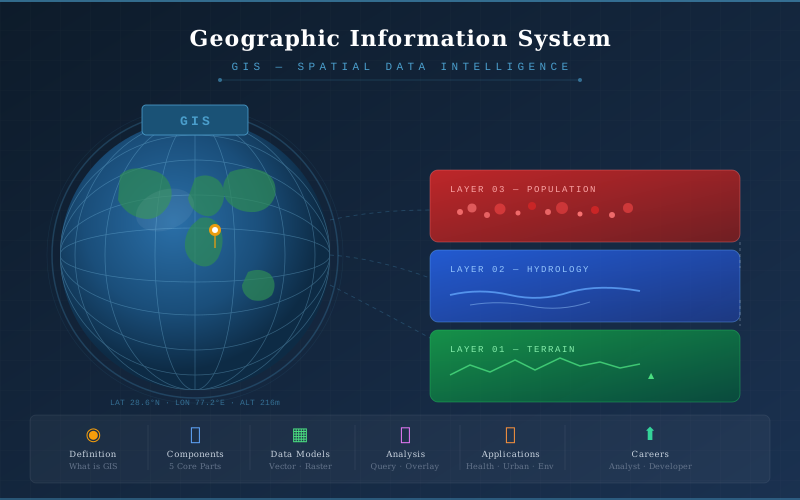
This article breaks down the six most important things you should know about GIS — covering its definition, core components, how data is structured, analytical capabilities, real-world applications, and the career landscape it supports.
1. What GIS Actually Is
A Geographic Information System is an integrated framework of hardware, software, data, and human expertise designed to capture, store, manage, analyze, and visualize spatial and geographic data. In simpler terms, GIS is a system that links information to location.
The key insight behind GIS is deceptively simple: almost everything that happens in the world happens somewhere. Crime, disease, commerce, migration, weather — all of these phenomena have a geographic dimension. GIS allows analysts and decision-makers to see patterns that would be invisible in a spreadsheet or database by placing data on a map and revealing spatial relationships.
GIS is distinct from a plain digital map. While a map is a static visual representation, a GIS is an interactive analytical environment. You can query it, layer it, model scenarios with it, and extract insights from it. Think of a GIS as a map you can interrogate with questions: Where are all the hospitals within 10 km of a flood zone? Which census tracts have both high poverty rates and poor access to broadband?
Key Distinction: GIS vs. GPS vs. Remote Sensing
These three technologies are often confused:
- GIS is a system for analyzing and displaying geographic data. It is the analytical engine.
- GPS (Global Positioning System) is a satellite-based technology for determining precise location. GPS data is often an input into GIS.
- Remote Sensing refers to collecting data about the Earth from a distance, typically via satellites or aircraft. Imagery from remote sensing is commonly used as a data layer within GIS.
2. The Core Components of a GIS
A functional GIS is not just software — it is a system with five interdependent components that must work together effectively.
Hardware
GIS runs on a range of hardware, from high-performance workstations and servers to mobile devices and drones. Historically, GIS required powerful machines due to the computational demands of processing large spatial datasets. Today, cloud computing has dramatically lowered hardware barriers, enabling GIS workloads to run on scalable infrastructure without significant local investment.
Software
GIS software provides the tools for data input, management, analysis, and visualization. The most widely used commercial platform is Esri’s ArcGIS suite, which dominates enterprise and government deployments. On the open-source side, QGIS is a powerful and widely adopted alternative. Other notable platforms include GRASS GIS, PostGIS (a spatial extension for PostgreSQL), and Google Earth Engine for cloud-based geospatial analysis at massive scale.
Data
Data is the lifeblood of any GIS. Spatial data describes the location and shape of features, while attribute data describes the characteristics of those features. Data comes from many sources: satellite imagery, field surveys, GPS devices, government datasets, aerial photography, and increasingly from IoT sensors and crowdsourced platforms like OpenStreetMap.
People
GIS is ultimately a human-driven system. GIS analysts, cartographers, data scientists, urban planners, and domain experts are required to design systems, interpret results, and communicate findings. Skilled practitioners understand not just the tools, but the domain knowledge needed to ask the right spatial questions.
Methods and Workflows
A GIS is only as good as the methods applied within it. Standardized workflows for data acquisition, quality control, projection management, and analysis ensure that outputs are reliable and reproducible. Poor methodology — such as using mismatched coordinate systems or failing to account for data currency — can lead to dramatically incorrect conclusions.
3. How GIS Data Is Structured
All GIS data falls into one of two fundamental data models: vector and raster. Understanding the difference between these models is essential to working effectively with spatial data.
Vector Data
Vector data represents geographic features as discrete geometric objects: points, lines, and polygons.
- Points represent features with no area, such as well locations, cell towers, or crime incidents.
- Lines (polylines) represent features with length but no width, such as roads, rivers, or utility lines.
- Polygons represent features with area, such as parcels, lakes, administrative boundaries, or building footprints.
Each geometric object in a vector dataset is associated with attribute data stored in a table, much like a relational database. For example, a polygon representing a county might have attributes including population, area, median income, and name. Vector data is excellent for representing discrete, clearly defined features and supports sophisticated topological analysis.
Raster Data
Raster data represents the world as a grid of cells (pixels), where each cell holds a value. This model is ideal for representing continuous phenomena: elevation, temperature, precipitation, land cover, or satellite imagery.
The resolution of a raster dataset — the size of each cell — determines the detail it captures. A 1-meter resolution digital elevation model captures fine terrain variation, while a 1-kilometer resolution climate dataset is appropriate for regional analysis. Raster processing is computationally intensive but powerful for modeling environmental and physical processes.
Coordinate Reference Systems (CRS)
Every piece of spatial data exists in a coordinate reference system, which defines how the two-dimensional coordinates in a dataset relate to locations on the three-dimensional Earth. Working with data from multiple sources requires ensuring all layers share the same CRS — a common source of errors in GIS workflows.
- Geographic coordinate systems (like WGS84, used by GPS) express location in latitude and longitude.
- Projected coordinate systems (like UTM or State Plane) express location in meters or feet on a flat plane.
Failing to account for CRS differences is one of the most common and costly mistakes in GIS workflows.
4. What You Can Do with GIS: Core Analytical Capabilities
GIS is far more than a digital atlas. Its real value lies in its analytical capabilities, which allow users to extract meaning from spatial data and model complex phenomena.
Spatial Query and Selection
The most fundamental GIS operation is selecting features based on location. A spatial query might ask: Which parcels are within 500 meters of a proposed highway? Which hospitals are located in earthquake hazard zones? These questions — trivial to pose, powerful in their implications — are answered instantly in a GIS environment.
Overlay Analysis
Overlay analysis combines two or more spatial layers to identify areas where multiple conditions co-occur. A suitability analysis for a new warehouse might overlay layers representing road access, zoning, flood risk, and land cost to identify optimal sites. This is one of the most widely used and powerful techniques in applied GIS.
Network Analysis
GIS can model flow along networks — roads, rivers, utility lines, and similar linear features. Network analysis enables:
- Routing — finding the shortest or fastest path between locations
- Service area delineation — determining what can be reached from a point within a given time or distance
- Flow modeling — simulating movement of water, traffic, or goods through a network
Logistics companies, emergency services, and transit agencies rely heavily on network analysis capabilities.
Terrain Analysis
Using elevation data, GIS can compute slope, aspect, hillshade, viewshed (what is visible from a given point), and watershed boundaries. These analyses are fundamental to environmental planning, military operations, telecommunications tower placement, and hydrological modeling.
Geostatistics and Spatial Interpolation
When data is sampled at specific locations but continuous values are needed across a surface, spatial interpolation techniques estimate values at unsampled locations. Common methods include:
- Kriging — a geostatistical approach that accounts for spatial autocorrelation
- Inverse Distance Weighting (IDW) — weights nearby observations more heavily than distant ones
- Spline interpolation — fits a smooth surface through sample points
These are essential for creating continuous maps of air quality, groundwater depth, or temperature from point measurements.
Geocoding and Reverse Geocoding
Geocoding converts textual addresses into geographic coordinates, enabling tabular data with address fields to be mapped and spatially analyzed. Reverse geocoding does the opposite — converting coordinates into human-readable addresses. These functions are fundamental to any application that involves mapping customer locations, event records, or administrative data stored as street addresses.
5. Real-World Applications of GIS
GIS is applied across virtually every domain where location matters — which is nearly every domain. The following examples illustrate its remarkable breadth.
Public Health and Epidemiology
GIS has been used in public health since John Snow famously mapped cholera cases in 1854 London, identifying a contaminated water pump as the source of the outbreak. Modern epidemiology uses GIS to track disease spread, identify high-risk populations, optimize vaccination distribution, and analyze environmental determinants of health outcomes. During the COVID-19 pandemic, GIS dashboards became essential tools for public communication and resource allocation worldwide.
Urban Planning and Smart Cities
City planners use GIS to analyze land use, model traffic patterns, assess infrastructure condition, and simulate the impacts of proposed development. Smart city initiatives integrate real-time GIS data from IoT sensors to manage traffic signals, optimize energy grids, and monitor environmental conditions dynamically.
Environmental Management
Conservation organizations and government agencies use GIS to map habitat, monitor deforestation, track wildlife migration, and assess the impacts of climate change. GIS supports environmental impact assessments, protected area design, and the monitoring of pollution and land degradation over time.
Precision Agriculture
Modern farms use GIS combined with GPS and remote sensing to practice precision agriculture — varying the application of water, fertilizers, and pesticides across a field based on spatially variable soil and crop conditions. This approach increases yields while reducing environmental impact, representing one of the most commercially significant applications of geospatial technology.
Emergency Management and Disaster Response
GIS is a cornerstone of emergency management. Before disasters, it supports hazard mapping and evacuation planning. During events, it enables real-time situational awareness and resource coordination. After disasters, it supports damage assessment and recovery planning. FEMA, the United Nations, and national disaster management agencies around the world rely on GIS platforms as their primary operational tool.
Business Intelligence and Site Selection
Retailers, franchisors, and real estate developers use GIS for trade area analysis, competitor mapping, demographic profiling, and site selection. The spatial dimension of customer data — where customers live, shop, and travel — provides insights unavailable from purely tabular analysis.
6. GIS Careers and the Modern Geospatial Industry
The geospatial industry is large, growing, and increasingly integrated with mainstream technology. Understanding the career landscape and technological trajectory is essential for anyone considering entering the field or incorporating GIS into their work.
Career Roles in GIS
GIS supports a wide range of professional roles:
| Role | Description |
|---|---|
| GIS Analyst | Performs spatial analysis, produces maps and reports for decision-makers |
| GIS Developer | Builds custom GIS applications, web maps, and spatial data pipelines |
| Cartographer | Specializes in map design and production, increasingly web-based |
| Remote Sensing Analyst | Focuses on satellite and aerial imagery processing and interpretation |
| Geospatial Data Engineer | Designs and maintains spatial databases and data infrastructure at scale |
| Spatial Data Scientist | Applies statistical and machine learning methods to spatial data |
The Convergence of GIS and Data Science
Modern GIS is rapidly converging with data science and software engineering. Python has become the dominant programming language in the geospatial community, with libraries such as GeoPandas, Shapely, Rasterio, and Fiona enabling sophisticated spatial analysis in code. This shift is enabling GIS workflows to be reproduced, automated, and scaled in ways that traditional point-and-click GIS software could not support.
Cloud GIS and the Democratization of Geospatial Technology
Cloud platforms have fundamentally changed GIS. Esri’s ArcGIS Online, Google Earth Engine, AWS Location Services, and Microsoft’s Planetary Computer make powerful geospatial capabilities accessible without on-premises infrastructure. This has lowered the barrier to entry for startups, small governments, and researchers while enabling analysis at planetary scale — processing petabytes of satellite imagery or routing billions of GPS traces — that would have been impossible a decade ago.
Emerging Trends
Several developments are shaping the near-term future of GIS:
- Digital twins — highly accurate 3D virtual replicas of cities and infrastructure, powered by GIS and real-time sensor data
- AI and machine learning — automating feature extraction from imagery, improving object detection, and enabling predictive spatial modeling
- Indoor mapping — extending GIS into building interiors for navigation, asset tracking, and facility management
- Real-time GIS — integrating live data streams from IoT devices, connected vehicles, and sensor networks to enable dynamic situational awareness
Conclusion
A Geographic Information System is far more than mapping software. It is a complete analytical framework for understanding the world through a spatial lens — integrating data from many sources, enabling powerful queries and models, and supporting decisions across virtually every sector of society.
Whether you are a software developer looking to add spatial capabilities to an application, a policy analyst seeking to understand demographic patterns, or an environmental scientist modeling habitat loss, GIS offers a set of tools and a way of thinking that can dramatically enhance your work. The six things covered in this article — what GIS is, its core components, how its data is structured, its analytical capabilities, its applications, and its career landscape — provide the foundation you need to engage meaningfully with this field.
The world is inherently spatial. GIS is the technology that lets us reason about it systematically.
This article covers GIS fundamentals as of 2025. The geospatial industry evolves rapidly; consult current documentation for the latest platform capabilities and best practices.