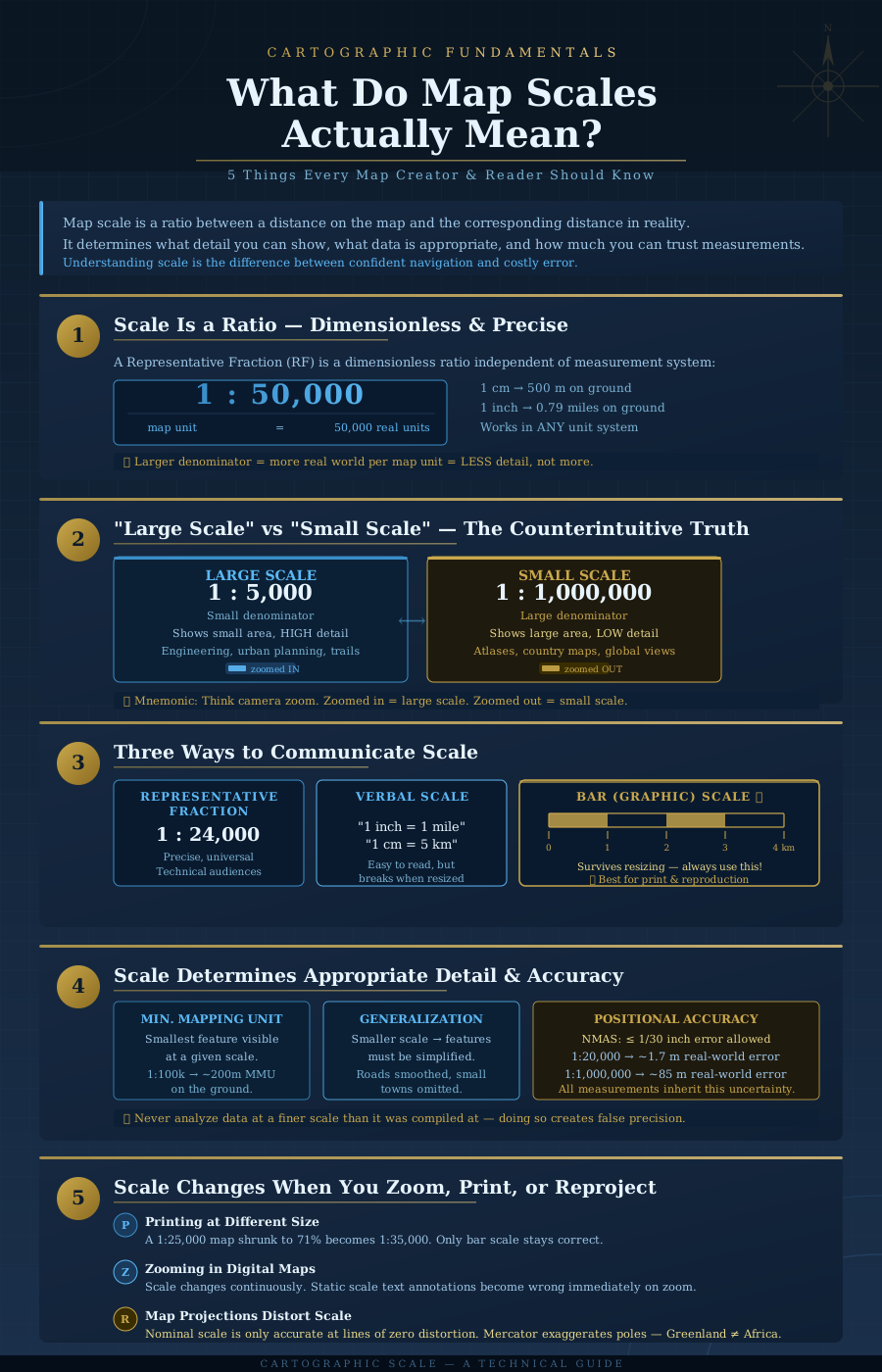
What Do Map Scales Actually Mean? 5 Things Every Map Creator & Reader Should Know
A Technical Guide to Cartographic Scale
Map scales are one of the most fundamental — and most misunderstood — concepts in cartography. Whether you’re a GIS analyst building a data pipeline, a designer laying out a city guide, or simply a hiker trying to estimate how far the next summit is, understanding scale is the difference between confident navigation and costly error. Yet despite its importance, scale is often reduced to a vague label printed in a map’s corner, rarely explained in depth.
This article breaks down map scales into five essential concepts that every map creator and reader should understand: what scale actually means mathematically, the difference between large- and small-scale maps, the three ways scale is communicated, how scale affects data accuracy, and what happens to scale when you zoom, print, or reproject a map.
1. Map Scales are Ratios — And It Means Exactly What It Says
At its most precise, map scales are representative fractions (RF): a dimensionless ratio between a distance on the map and the corresponding distance in the real world. A scale of 1:50,000 means that one unit on the map equals 50,000 of the same units on the ground. One centimeter on the map equals 50,000 centimeters — or 500 meters — in reality. One inch equals 50,000 inches, or about 0.79 miles.
This dimensionless property is what makes the representative fraction so powerful: it works regardless of the measurement system you’re using. There’s no need to specify “centimeters” or “inches” because the ratio is self-consistent across any unit.
Key insight: The denominator of a scale fraction is always the real-world multiplier. Larger denominators mean more real-world distance packed into every map unit — which means less detail, not more.
This is why scale is often counterintuitive to newcomers. A “larger” scale number (e.g., 1:1,000,000) doesn’t mean you see more of the world in richer detail — it means you’re seeing a much larger area compressed into the same space, resulting in less detail per unit area.
2. “Large Scale” and “Small Scale” Are Often Confused — Here’s the Correct Usage
The terms “large scale” and “small scale” are among the most consistently misused in geographic communication. The confusion is understandable: intuitively, a map that shows a large area seems like it should be a “large-scale map.” But in technical cartography, the opposite is true.
Large-Scale Maps
A large-scale map has a large representative fraction — meaning the denominator is small. Examples include 1:1,000, 1:5,000, or 1:25,000. These maps show a small geographic area in great detail. Think of a building floor plan, a neighborhood street map, or a topographic map of a single mountain. Large-scale maps are used in urban planning, engineering surveys, and precision navigation.
Small-Scale Maps
A small-scale map has a small representative fraction — a large denominator. Examples include 1:500,000, 1:1,000,000, or 1:10,000,000. These maps show a large geographic area with generalized features. A world atlas, a country-level administrative map, or a continent map are all small-scale. Small-scale maps are used for overviews, regional planning, and geopolitical analysis.
Mnemonic: Think of it like a camera zoom. “Zoomed in” = large scale. “Zoomed out” = small scale. The fraction itself tells you: 1/25,000 is a much larger number than 1/1,000,000.
This distinction matters enormously for data selection. Importing a road network dataset digitized at 1:250,000 into a map intended for 1:5,000 display will produce results that look cartographically wrong — lines that are too thick, curves that are too smooth, and features that appear jagged when rendered at the higher zoom level.
3. There Are Three Ways to Communicate Scale — Each Has Strengths and Weaknesses
Maps communicate scale in three distinct ways, and each method has practical trade-offs. Professional map creators should understand when to use each, and often include more than one for clarity.
Representative Fraction (RF)
As discussed above, the RF is the most mathematically rigorous expression of scale. It appears as a ratio such as 1:24,000 or 1/24,000. The RF is universally understood by cartographers and GIS professionals, works across measurement systems, and is unambiguous. However, it means little to a general audience — most people don’t have an intuitive feel for what 1:50,000 looks like on the ground.
Verbal Scale
A verbal scale expresses the relationship in plain language: “One inch equals one mile” or “One centimeter equals five kilometers.” This is immediately interpretable by any reader with basic measurement literacy. However, verbal scales are tied to a specific unit system, making them less portable across international audiences, and they become inaccurate if the map is reproduced at a different size.
Graphic (Bar) Scale
A bar scale — also called a linear scale — is a drawn line or bar subdivided into real-world distance units. It is the most robust form of scale communication because it scales proportionally with the map itself. If a map is printed at 75% of its intended size, the bar scale shrinks accordingly and remains correct. Verbal and representative fraction scales, by contrast, become incorrect when a map is physically resized.
Best practice for map creators: Always include a bar scale on any map that may be printed, photocopied, or reproduced at variable sizes. This is the only scale type that survives resizing intact.
For digital interactive maps, where users zoom freely, traditional scale expressions require dynamic updating. Most web mapping platforms (such as Leaflet, Mapbox, and Google Maps) include dynamic scale bars that update automatically as the user zooms in or out.
4. Scale Determines How Much Detail Is Appropriate — And Getting It Wrong Has Consequences
Scale is not merely a label — it dictates the minimum mapping unit, the appropriate level of generalization, and the reliability of spatial measurements derived from the map. This has practical implications for both data quality and cartographic honesty.
Minimum Mapping Unit (MMU)
Every map has a minimum mapping unit: the smallest real-world feature that can be meaningfully represented at a given scale. At 1:100,000, a feature smaller than roughly 2mm on the map — corresponding to about 200 meters on the ground — cannot be represented with any precision. Trying to show such features produces visual noise and false precision.
Land cover and land use datasets are particularly susceptible to MMU violations. A land use polygon created from 30-meter satellite imagery carries inherent positional uncertainty. Displaying it at a scale that implies meter-level precision is cartographically misleading.
Generalization
At smaller scales, features must be generalized — coastlines are smoothed, roads are simplified, small settlements may be omitted or merged. The goal of generalization is not to falsify reality, but to present an accurate impression of geographic relationships at a scale where full detail would create visual clutter and be counterproductive.
Generalization algorithms — including Douglas-Peucker simplification, Visvalingam-Whyatt, and topology-preserving methods — are key tools for managing this process in GIS workflows. Map creators should apply these algorithms deliberately, rather than allowing rendering engines to display high-resolution data at inappropriate scales.
Positional Accuracy
The U.S. National Map Accuracy Standards (NMAS) state that for maps at scales larger than 1:20,000, no more than 10% of tested points should be more than 1/30 inch from their true position on the map. This corresponds to about 1.7 meters of real-world error at 1:20,000. At 1:1,000,000, the equivalent tolerance balloons to about 85 meters. Any spatial analysis — distance calculations, area measurements, overlay operations — inherits this uncertainty.
Practical rule: Never use a dataset for analysis at a scale finer than the scale at which it was originally compiled. Doing so inflates false precision and can produce seriously erroneous results in planning or engineering contexts.
5. Scale Changes When You Zoom, Print, or Reproject — And Most People Don’t Account for This
Perhaps the most overlooked aspect of map scales is that it is not fixed. The scale printed on a map is only accurate under specific conditions, and several common operations change it in ways that are easily missed.
Printing at a Different Size
If a map designed at 1:25,000 for an A3 sheet is printed on A4 paper (at approximately 71% of the original size), the scale changes to roughly 1:35,000. The verbal scale and representative fraction become wrong. Only a bar scale remains accurate. This is why professional cartographers specify both the intended print size and the scale together.
Zooming in Digital Environments
In web mapping and desktop GIS, scale changes continuously as users zoom. The displayed scale bar updates, but any static scale annotation (e.g., text labels saying “1:50,000”) becomes incorrect the moment the user zooms. Map creators should avoid embedding fixed scale text into digital map products unless the zoom is locked.
Map Projections and Scale Distortion
This is the most technically significant issue. Every map projection introduces scale distortion, because the curved surface of the Earth cannot be flattened without stretching or compressing some areas. The stated scale of a map is its nominal scale — the scale that is accurate only along specific lines or points called lines of zero distortion or standard parallels.
On a Mercator projection, for example, scale is accurate along the equator but becomes increasingly exaggerated toward the poles. Greenland appears roughly the same size as Africa on a Mercator world map, even though Africa is about 14 times larger in reality. A map with a nominal scale of 1:50,000,000 might have an actual local scale of 1:10,000,000 at high latitudes.
For large-scale maps covering small areas (a city, a county), projection distortion is minimal and rarely matters in practice. For small-scale maps covering continents or the globe, projection choice has a profound effect on perceived scale relationships and must be communicated explicitly.
For map creators: Always document the projection used alongside the nominal scale, especially for small-scale or regional maps. Users performing measurements or analyses need to know where scale is accurate and where it is not.
Equal-area projections (such as Albers, Lambert Azimuthal Equal-Area, or Mollweide) preserve area relationships at the expense of shape, making them appropriate for thematic maps showing quantities distributed across space. Conformal projections (such as Mercator or Lambert Conformal Conic) preserve local shapes and angles, making them preferable for navigation and weather mapping. No single projection preserves both area and shape simultaneously — understanding this trade-off is essential for every cartographer.
Putting It All Together
Map scales are not footnotes — they are a foundational design decision that affects every other choice a cartographer makes: what data to include, how much to generalize, which projection to use, and how to communicate uncertainty to the reader. For map readers, understanding scale transforms a static image into a reliable spatial tool.
Here is a concise summary of the five things every map creator and reader should know:
- Scale is a ratio (representative fraction) expressing the relationship between map distance and real-world distance — completely independent of units.
- Large-scale maps show small areas in high detail; small-scale maps show large areas with less detail. The fraction’s denominator tells you which is which.
- There are three ways to show scale (RF, verbal, bar scale), and only the bar scale survives resizing — always include one.
- Scale determines appropriate detail and data accuracy. Never display or analyze data at a finer scale than it was compiled at.
- Scale changes when maps are printed, zoomed, or reprojected. Know where your nominal scale is accurate, and communicate that to your users.
Whether you’re creating a precision engineering survey, a public transit guide, or a global climate visualization, these five principles will help you produce maps that are not only beautiful, but scientifically sound and trustworthy.
— End of Article —